

A water storage tank is one of the longest-lived assets a community will own, with a well-designed and properly maintained tank often serving for 50 years or more. The right choice of type, size and location helps a community to maintain water distribution system pressure, supply adequate fire flow and water quality for its customers. A poor choice can lead to excessive water age, higher operating costs and costly modifications later.
Storage tanks serve four main functions in a distribution system:
- Maintain service pressure across the area the tank serves.
- Provide equalization, absorbing short-term hourly fluctuations in demand so wells, treatment plants and pump stations can run at steady, efficient rates.
- Supply fire flow when demand spikes far beyond what pumps can deliver.
- Hold emergency reserves that keep water flowing during a power outage, pump failure or main break.
For years, many utilities kept tanks full or nearly full to be ready for fires and peak demand. That approach is safe for supply but poses issues with maintaining water quality. Water that sits too long can lose its disinfectant residual and stratify by temperature, while tanks in cold climates also require careful operation to prevent freezing. Today’s best practice balances supply readiness against water age, and that balance should shape every decision below.
How Do Water Storage Tanks Work in a Distribution System?
Water storage tanks that “float” on the distribution system fill when pumps deliver more water than customers are using, then drain to make up the difference when demand outpaces pumping. For a tank that floats on the system, its water-surface elevation reflects the hydraulic grade of the pressure zone and helps establish system pressure. As the tank level rises and falls, pressures throughout the zone change accordingly.
This regular fill-and-draw cycle also helps limit water age. An optimum operating cycle should exchange a meaningful portion of the tank’s volume rather than keeping the water level held at a constant level. Tanks with little turnover are more susceptible to excessive water age and related water-quality problems.
Some older storage facilities are not configured to float directly on the system. In some cases, the tank’s high water level sits below the system’s normal hydraulic grade, requiring pumps or controls to move stored water back into the distribution system. These tanks may have limited turnover, allowing water to remain in storage for long periods and requiring additional attention to turnover and mixing.
Storage Zones in a Water Tank
Engineers divide a tank’s volume into zones, each with its own purpose:
| Zone | Where it sits | What it does |
| Operating | Upper operating range | Volume between normal pump-on and pump-off levels used during routine pump cycling. |
| Equalization | Within the usable operating range | Balances differences between water-supply flowrates and customer demand, filling when supply exceeds demand and drawing down when demand exceeds supply. |
| Fire and Emergency | Reserved usable storage | Provides water for required fire flow and emergencies such as power outages, pump failures or other disruptions. |
| Dead (inactive) | Lowest portion | Water that cannot be withdrawn while maintaining required system conditions or otherwise is not considered usable storage. Limited turnover can also create water-quality concerns. |
The goal is to provide enough usable storage for daily demand, fire protection and emergencies while promoting regular turnover so excess water does not remain in the tank long enough to create water-quality problems.
Ground Storage Tanks vs. Standpipes vs. Elevated Water Towers
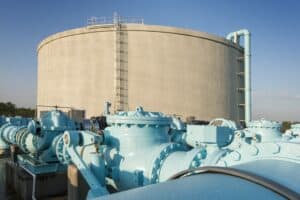
Most communities meet their storage needs with ground tanks, standpipes, elevated tanks or a combination of the three. The best fit depends on the required storage volume and pressure, available site elevation, pressure-zone configuration, pumping needs, water-quality goals and long-term cost.
Ground storage tanks are typically flat-bottomed steel or concrete structures with a diameter greater than their height. Unless they are located at sufficient natural elevation, they require pumps to deliver water at suitable system pressures. They can provide large storage volumes at a comparatively low construction cost per gallon and are commonly located at treatment plants, wells and pump stations.
Standpipes are ground-supported tanks that are taller than they are wide. Their water-surface elevation can provide gravity pressure, but usable pressure decreases as the tank drains. The upper portion generally provides usable operating storage, while water below the minimum operating level may not be available without pumping because it cannot maintain adequate system pressure. Standpipes can be practical for smaller systems or locations where natural ground elevation helps meet the required hydraulic grade.
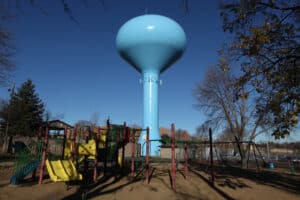
Elevated tanks place the water-containing bowl on a tower, allowing nearly all of the stored volume to provide gravity pressure within the tank’s designed operating range. They are often used where natural topography cannot provide the elevation needed to maintain system pressure through ground-supported tanks or where emergency supply is needed without the use of constant-pumping.
Common elevated-tank styles include multi-legged tanks, spheroid tanks supported by a single steel pedestal, fluted-column tanks supported by a wide steel column that can enclose piping and equipment, and composite tanks that pair a welded-steel water container with a reinforced-concrete pedestal. Because the concrete pedestal does not require the same exterior recoating as an all-steel support structure, composite construction reduce long-term coating maintenance, which can result in cost-savings especially for large-capacity tanks.

Sizing and Siting a Water Storage Tank
Every new tank is a balance of hydraulics, water quality, cost and community fit. These are the questions we work through with clients.
Direct vs. Indirect Pumping Systems
In a direct pumping system, pumps provide the pressure needed to move water through the distribution system. In an indirect pumping system, water is pumped into an elevated storage tank that floats on the distribution system, using gravity to maintain system pressure and meet changing demands. Elevated tanks are commonly configured this way, offering several potential advantages:
- Lower peak pumping requirements and more consistent pressure as demand rises and falls
- More consistent pumping rates, allowing pumps to operate closer to efficient operating ranges
- Opportunities to reduce energy costs by shifting pumping to off-peak periods, when rate structures allow
- Greater hydraulic stability as stored water helps buffer changes in system supply vs. real-time system demands
- Stored water that can help meet fire-flow demands and maintain service during certain pumping or power interruptions
What Size Water Storage Tank Does a Community Need?
Many communities use average-day demand as a starting point, but the right tank size also depends on emergency reserves, fire protection, pumping capacity and future demand. Stored water can help maintain service during pumping or power interruptions, while fire-flow requirements often influence the final capacity.
Bigger is not automatically better. An oversized tank can turn over too slowly, increasing water age and creating water-quality challenges. The goal is enough storage for operations, emergencies and fire protection while maintaining good circulation and turnover.
How Tall Does a Water Tower Need to Be?
A water tower’s operating water level in indirect pumping systems, may need to be roughly 140 to 185 feet to provide a static pressure of approximately 60 to 80 psi. Every 2.31 feet of water elevation corresponds to a water pressure of 1 psi, but actual pressure varies with the tank’s water level, customer elevation, system demand and pipe friction. The tower must also maintain the minimum pressures required by state and local design standards, including during peak-demand and fire-flow conditions. Building on high ground is one consideration to reduce the structural height needed to achieve the target water-surface elevation for a pressure plane.
Choosing a Water Tower Location
The site and the tower height are evaluated together. Building on high ground can allow for a shorter, less expensive tower. When comparing sites, consider:
- Hydraulic grade. Higher ground elevation can mean a shorter tower for the same operating pressure.
- Position in the pressure zone. A well-placed tank can support peak demand and stabilize pressure throughout the zone. However, a tank at the edge of the system may experience poor turnover and increased water age. Hydraulic and water quality modeling can help compare sites before deciding.
- Distance to a transmission main. Tanks may fill and drain at high flow rates. A site far from a sufficiently-sized main may require a costly new connecting pipe.
- Land, access and neighbors. You need room for construction cranes and future maintenance equipment, reliable access, and a parcel you can acquire. Overhead and underground utilities may require relocation, adding time and coordination.
- Soils and foundation. A full tank is extremely heavy, and tall tanks must resist wind and, in some regions, seismic loads. An early geotechnical investigation can identify problem sites before you’re committed.
Designing Around Water Age
Water age deserves a seat at the table from the start, not as an afterthought. Older water can lose disinfectant residual, form disinfection byproducts (DBPs), contribute to nitrification in chloraminated systems, and create taste and odor concerns. Hydraulic and water-quality modeling can help determine the right tank site, size and operating range to promote turnover and keep water fresh.
Long-Term Water Storage Tank Maintenance
Building the tank is the beginning of the commitment. Regular inspection and maintenance protect water quality, catch small problems before they become structural ones, and extend the tank’s service life.
How Often Should Water Storage Tanks Be Inspected?
Water storage tanks should get a full interior and exterior inspection at least every three to five years or more frequently as conditions and state requirements warrant. A thorough inspection covers sanitary conditions, structure, coatings, safety equipment and site security.
There are three main ways to inspect a tank’s interior:
| Method | Tank status | Strengths | Limitations |
| Dry (drained) inspection | Drained and out of service | Provides the most direct access to coatings, steel and appurtenances | Requires operational planning, confined-space procedures, system operation without the tank, and disinfection procedures to restore operation |
| Remotely operated vehicle (ROV) | In service | Avoids draining and confined-space entry; produces video documentation | Primarily visual and may have limited access to certain surfaces or appurtenances |
| Rafts for float inspection or Inspection divers | In service | Allows close visual inspection, may permit sediment removal or limited measurements | Requires rigorous sanitary and diver-safety procedures; remains less comprehensive than direct dry access |
Timing requires careful planning. Before a dry inspection, confirm that the system can maintain pressure, supply and fire protection without the tank. A test shutdown can identify operational issues in advance. In cold climates, schedule entry after ice and other unsafe conditions have been eliminated.
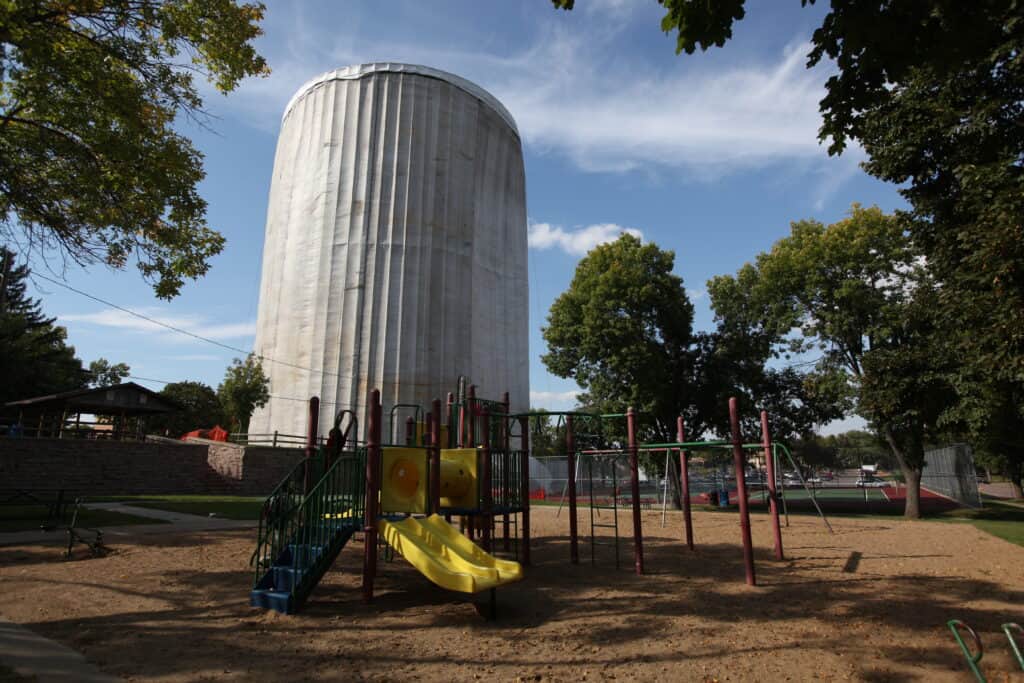
When Does a Water Tank Need to Be Repainted?
Most steel water tanks need to be repainted roughly every 15 to 30 years, although the actual timing depends on the coating system, surface preparation, application quality, exposure conditions and ongoing maintenance. Regular inspections help determine when recoating is needed. Interior coatings in contact with drinking water must be certified under NSF/ANSI/CAN 61 and 600. Older tanks may still contain lead-based coatings, including beneath newer layers of paint, so testing for lead before abrasive blasting or other coating removal is important. If lead is present, containment, worker protection and proper waste handling can add significant mitigation efforts, disposal, and project costs that should be included in the project budget from the start.
What Is Cathodic Protection for Steel Water Tanks?
Cathodic protection (CP) helps prevent corrosion on a steel tank’s submerged interior, particularly where the coating has pinholes or damage. Sacrificial anode systems use zinc or magnesium that corrode in place of the steel, while impressed current systems use an external power source. Combined with a good coating system, CP can extend the time between repaints, but regular testing is necessary to ensure it continues to work properly.
Water Tank Safety, Security and AWIA Compliance
Safety requirements keep evolving, including the number and size of access hatches, vent and overflow screening, overflow pipe height, and fall protection systems. Each inspection is a chance to bring the tank up to current standards. Physical security matters too: tank sites need fencing, locked and alarmed hatches, and intrusion monitoring.
Do Water Storage Tanks Need Mixing Systems?
Many water storage tanks benefit from a mixing system because poor turnover and mixing can create stagnant zones and increase water age. Tanks in cold climates benefit from mixing in order to prevent ice formation as well. Tanks with a single inlet/outlet pipe can be particularly susceptible to short-circuiting, where newer water leaves the tank before older water is fully exchanged. Mixing systems generally address this in two ways:
- Passive mixing uses the energy of incoming water to circulate and blend the tank contents. Examples include multi-port inlets, separate inlet and outlet configurations, and systems that direct flow differently during filling and draining. Because passive mixing relies on hydraulic flow, its effectiveness depends on tank filling and turnover.
- Active mixing uses powered equipment to circulate water independently of tank filling and can operate continuously or on a controlled schedule. Some systems can be paired with aeration equipment that strips volatile disinfection byproducts, particularly THMs, from the water. The tradeoff is the need for power and ongoing equipment maintenance.
Planning Your Community’s Next Water Storage Project
There’s no one-size-fits-all water storage tank. The right type, size, site and equipment depend on your terrain, demand patterns, fire flow needs, water quality goals and budget, both for construction and for decades of upkeep. Putting off inspections, recoating or equipment upgrades can contribute to water quality problems, customer complaints, costly repairs and service disruptions.
HR Green has extensive experience planning, designing, inspecting and rehabilitating water storage tanks for public and private clients. Whether you’re planning a new tank, evaluating an aging one or preparing for your next inspection, contact our team to talk through your options.