
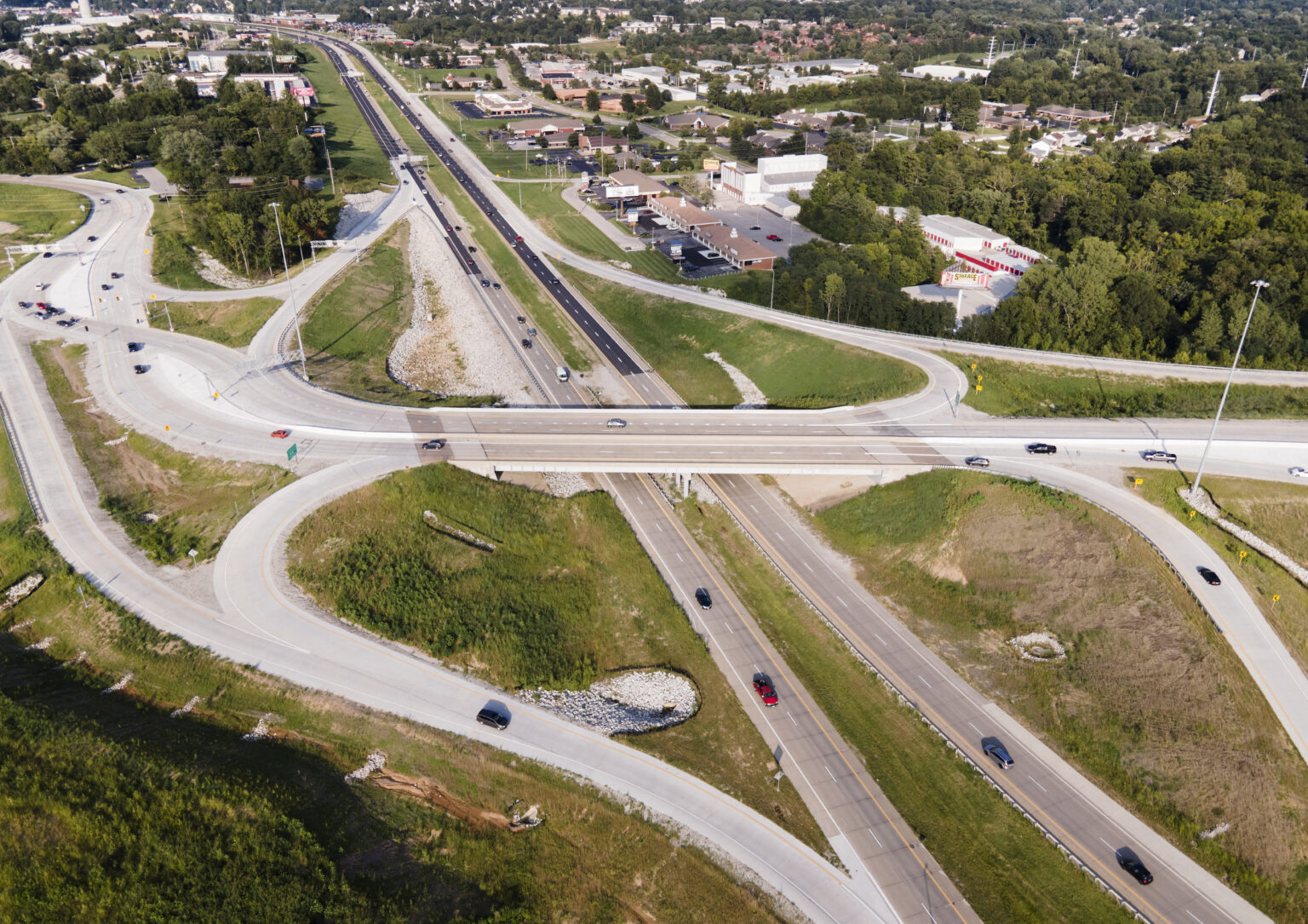
Interchanges play a critical role in how people, goods, and services move through a region. When they function well, they improve mobility and create safer, more reliable travel. When they do not, the impacts can be significant: congestion, driver confusion, crash risks, emergency response delays, and costly barriers to future growth.
The right interchange design solution requires a careful evaluation of the corridor, the client’s goals, and the needs of everyone who uses the transportation system. Through thoughtful transportation engineering, corridor planning, and data-driven analysis, communities can identify interchange design solutions that improve safety, operations, and long-term value.
Matching Interchange Type to Corridor Needs
HR Green approaches interchange design with a toolbox mindset. Innovative interchange configurations can provide meaningful benefits when applied in the design that best solves the problem.
For some corridors, that may mean improving traffic flow through a highly congested interchange. For others, safety may be the primary driver, especially where crash history, short weaving segments, limited sight distance, or heavy turning movements create risk for drivers, pedestrians, bicyclists, or emergency responders. In many cases, the best solution must be accomplished by improving operations while reducing conflict points and by creating a clearer, safer experience for all users. In addition to traditional diamond interchanges, HR Green has demonstrated success in implementing the following interchange types:
- Diverging Diamond Interchange
- Single-Point Urban Interchange
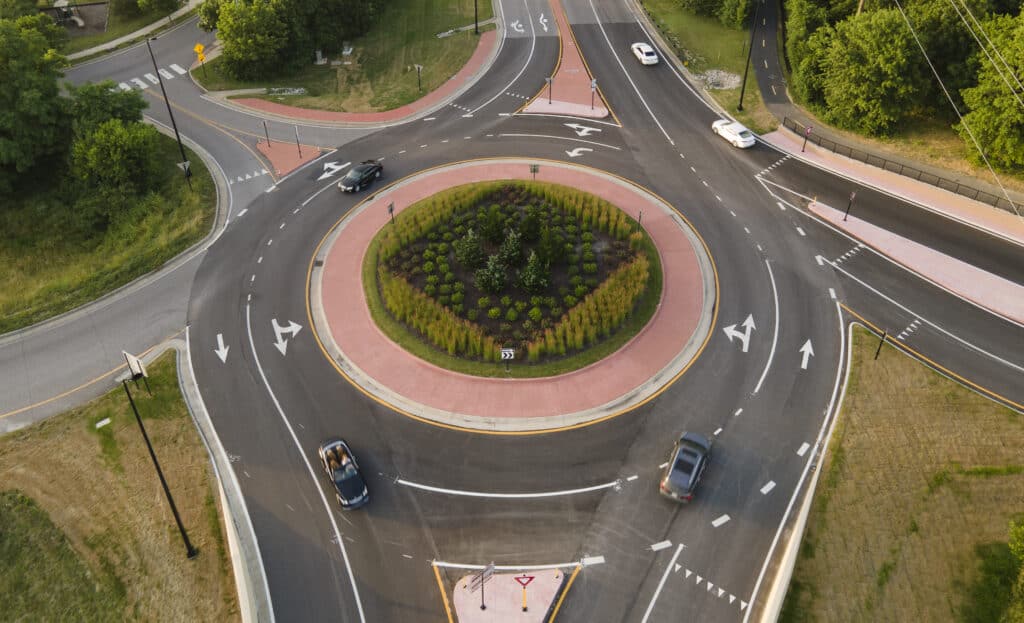
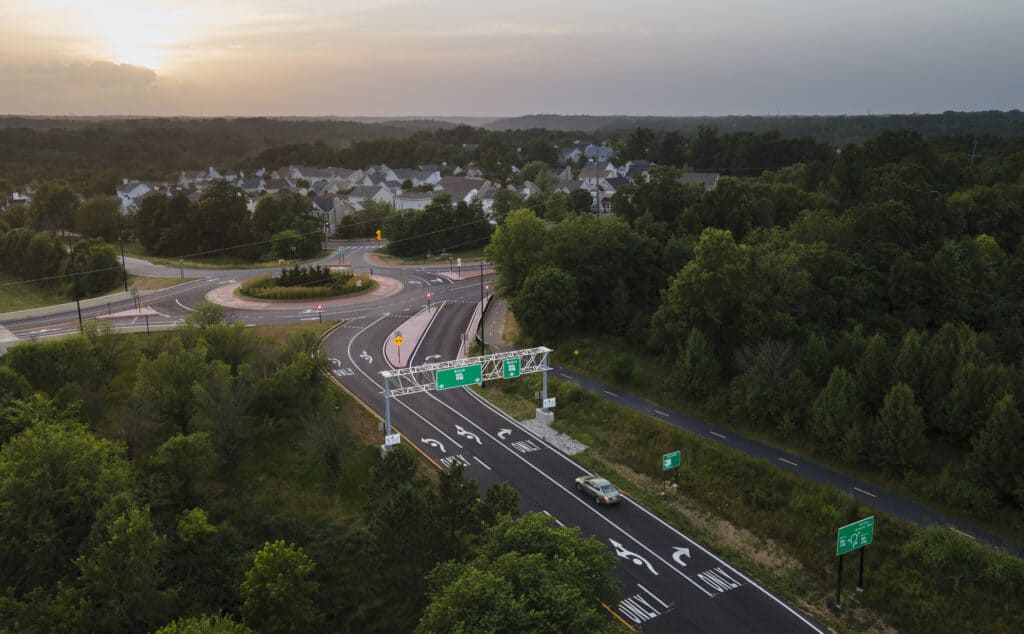
- Roundabout Interchange
- Continuous Flow Interchange
- Tiered, Flyover Interchanges
- System Interchanges with Collector-Distributor Access
Each of these options comes with tradeoffs. Some require more right-of-way while others require greater driver familiarity, additional signage, or more complex traffic signal operations. Some may better support pedestrians and bicyclists, and others may be better suited for high-volume regional freight routes. That is why the evaluation process matters.
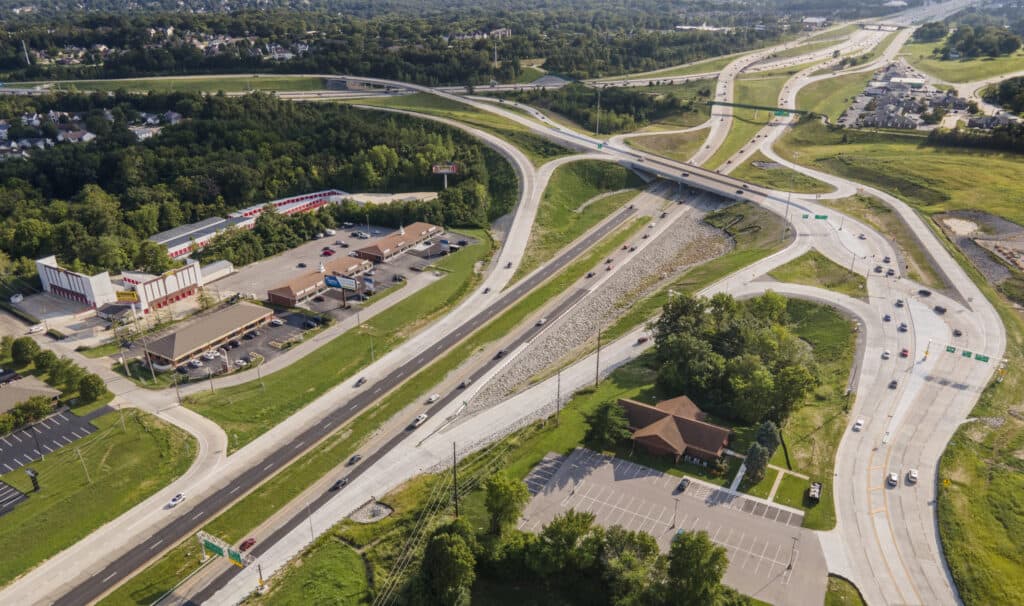
A Data-Driven Transportation Engineering Process for Safer Interchange Design
HR Green begins by working with clients to understand the project goals. Is the priority to:
- Reduce crashes?
- Improve peak-hour operations?
- Replace aging bridge infrastructure?
- Create safer pedestrian and bicycle connections?
- Align with available funding?
Often, complex locations include a combination of these.
From there, the team evaluates existing conditions through data collection, traffic analysis, crash history review, field observations, and coordination with agencies and stakeholders. The team may begin with a broad range of potential concepts, then use a structured screening process to narrow the options based on performance, safety, cost, constructability, right-of-way needs, environmental considerations, and community priorities.
This process allows clients to choose the most practical and beneficial options. More detailed analysis can then be completed for the strongest alternatives, based on predetermined evaluation criteria and measures of effectiveness. These analyses may use traffic operations modeling, geometric layouts, planning-level cost estimates, bridge considerations, property impacts, utility conflicts, drainage needs, and construction phasing.
In some cases, public engagement helps communities compare alternatives and understand how each option may affect daily travel, nearby properties, access, and long-term corridor performance, resulting in the selection of a preferred alternative.
Beyond Geometry: Integrating Bridges, Drainage, and Multimodal Needs
Successful interchange design also extends far beyond geometry. All grade separated interchange projects involve bridges, and bridge decisions can have a major impact on cost, schedule, construction staging, and long-term maintenance. Structure type studies help evaluate materials, span arrangements, foundation needs, vertical clearance requirements, widening options, and opportunities to avoid or reduce impacts. A design that improves traffic flow but creates unnecessary bridge complexity may not be the best overall solution.
Other design features, such as drainage and stormwater design, are also critical, particularly where roadway widening, ramp modifications, or bridge improvements change runoff patterns. Utilities, lighting, signals, intelligent transportation systems, pavement design, signing, striping, and access management must all be coordinated into a cohesive plan. In urban or suburban settings, multimodal transportation design, including pedestrian and bicycle accommodations, may also be central to the project’s success.
Real World Applications for Innovative Interchange Design
Route 94, Route 364, and Muegge Road Interchange
The Route 94, Route 364, and Muegge Road Interchange in St. Charles County, Missouri, illustrates how an innovative interchange solution can improve access, safety, and mobility within an existing transportation network. The project added traffic movements that had not previously existed, including access from eastbound and westbound Route 94 to northbound Muegge Road and from southbound Muegge Road to eastbound and westbound Route 94. The solution included a Diverging Diamond Interchange, bridge widening to accommodate an additional southbound lane, and adjacent roadway improvements that supported future travel volumes. The completed project provided direct access for all movements, improved safety for the traveling public, and reduced adverse travel for motorists moving to and from Muegge Road.
Route 109 and Route 100 Interchange
The Route 109 corridor improvements near Route 100 in Wildwood, Missouri, show how interchange and corridor planning can support safety, capacity, and multimodal connectivity. The project built on earlier corridor improvements and included additional roundabouts, bridge rehabilitation, and a grade-separated pedestrian crossing to support the community’s expanding trail network. By combining roadway capacity improvements, bridge work, and pedestrian connectivity, the project advanced a broader corridor vision rather than treating the interchange as an isolated asset.
US Highway 61 and Missouri Route 47 Interchange
The US Highway 61 and Missouri Route 47 interchange project in Troy, Missouri highlights the role of detailed analysis in selecting the right solution. The corridor faced congestion tied to heavy turning movements, close intersection spacing, a narrow bridge cross-section, and a short weaving segment near high-speed traffic. HR Green collected and analyzed traffic data, crash history, and GPS-enabled travel-time information, then evaluated multiple interchange concepts using detailed modeling tools. After reviewing traffic operations, property impacts, constructability, and construction costs, a Diverging Diamond Interchange emerged as the preferred solution to meet the project goals.
These projects reflect a common theme: the most effective interchange solution is the one that responds to the specific conditions of the corridor. Sometimes that means using an innovative geometry. Sometimes it means modifying bridge infrastructure, improving ramp spacing, adding roundabouts, addressing pedestrian needs, or coordinating multiple funding sources—or it might require all of these elements working together.
Designing Interchanges That Support Communities and the Future
As delivery methods continue to evolve, clients are also looking for partners who can support projects under traditional design-bid-build models as well as accelerated delivery approaches such as design-build. These methods can help advance critical infrastructure improvements more quickly, but they also require sound decision-making, clear documentation, and close coordination among owners, designers, contractors, agencies, and stakeholders.
For HR Green, the goal is not simply to design an interchange. It is to help clients understand the issue, evaluate the available tools, compare the tradeoffs, and move forward with a cost-effective and creative solution that supports safety, mobility, constructability, and long-term value.
Communities and transportation agencies are facing growing pressure to make the most of limited funding. Interchanges are often among the most visible and complex places where priorities come together. With thoughtful planning, technical evaluation, innovation, and practical design, these critical connections can become safer, more efficient, and better aligned with the needs of the people and communities they serve.
Whether your community is addressing safety concerns, traffic congestion, aging infrastructure, or future growth, the right interchange design solution starts with goal setting and proper planning to identify the best traffic flow and safety solutions for our clients. Partner with HR Green for transportation engineering, corridor planning, and innovative interchange design strategies that deliver lasting safety, mobility, and value.