

Municipal infrastructure needs are often unpredictable. When challenges or opportunities arise, the ability to respond quickly can significantly affect project schedules and delivery.
That is one reason Master Service Agreements (MSAs) have become an important tool in municipal project delivery. While MSAs are often viewed primarily as procurement vehicles, their role extends beyond contracting. They help public agencies reduce administrative burden, access technical support more quickly, respond to evolving needs, and build long-term partnerships with consultants who understand their systems, standards, and goals.
What Is a Master Service Agreement?
A Master Service Agreement is a contractual framework that establishes the general terms and conditions governing the relationship between a client and a consulting firm. Rather than negotiating a new contract for every project, the parties execute the MSA once and then issue individual task orders or work orders under that agreement as needs arise.
The MSA typically defines:
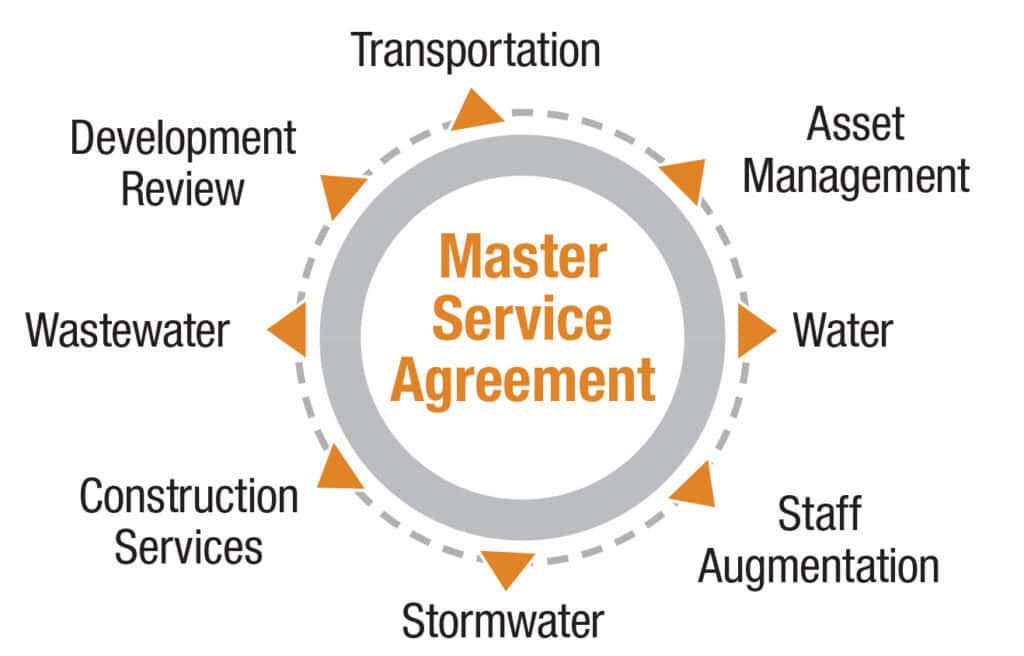
- Scope of services that may be provided
- Standard terms and conditions
- Insurance requirements
- Liability and indemnification provisions
- Payment terms
- Ownership of documents and intellectual property
- Dispute resolution procedures
- Contract term and renewal provisions
- Compliance with applicable regulations
Each task order issued under the MSA contains the specific scope, schedule, and fee for that individual project, while the MSA governs the overarching contractual relationship.
How Do MSAs Reduce Administrative Burden?
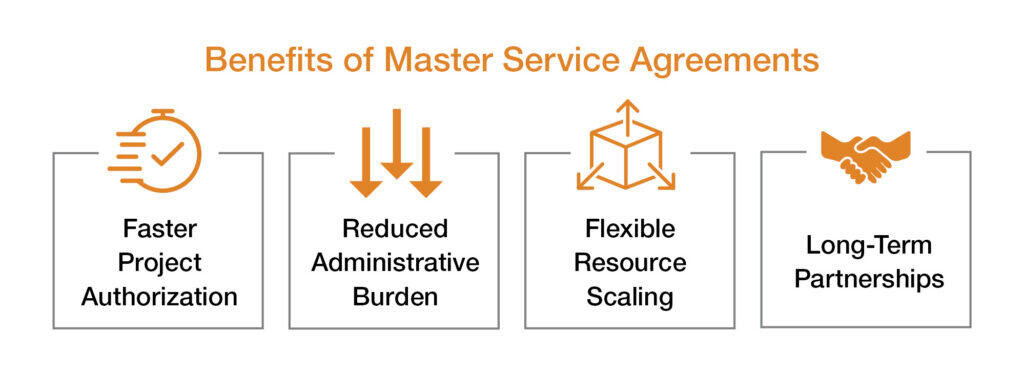
One of the most important benefits of an MSA is responsiveness. Municipalities often face infrastructure needs that require action before a traditional procurement process can be completed. When a consultant is already under contract, the agency can move directly into defining the project scope, schedule, and fee instead of starting from the beginning with a new request for proposals. That responsiveness is especially valuable during emergencies—after a storm event, utility failure, or urgent infrastructure concern, communities need support from people who can quickly understand the issue, evaluate options, and help move solutions forward.
This speed comes with less effort on both sides. The agency does not need to repeat a full procurement and contracting process for each assignment, and the consultant does not need to prepare a full proposal package for every project. Each task order still requires a clear scope, fee, schedule, and deliverables, but the administrative lift is lighter because the broader terms are already established. For communities with limited staff capacity, or without dedicated procurement staff, that reduced burden is often as valuable as the speed itself.
MSAs also offer flexibility to scale. Because they can be structured as time-and-material or not-to-exceed agreements, municipalities pay only for active work, which supports budgeting and lets communities scale resources up or down as project demands change.
Over time, this structure builds something beyond contract efficiency: a working relationship. Consultants who work closely with a municipality come to understand its systems, priorities, and challenges, which translates into better work, fewer miscommunications, and more proactive problem-solving.
Using Master Service Agreements for Engineering Staff Augmentation
One growing use of MSAs is staff augmentation, in which consulting personnel work directly within a municipal department to address staffing gaps or workload surges. An engineer or project manager may work onsite several days a week with access to municipal systems and processes. The agency gains experienced support without adding a full-time position, while the consultant develops a deeper understanding of local operations and needs.
Clear boundaries are essential. Consultants should not review their own work or participate in decisions that create conflicts of interest. With appropriate guardrails, staff augmentation can be an effective option for communities facing staffing challenges.
A Note on Terminology
MSAs go by different names depending on the client, state, or agency involved. You may encounter them referred to as:
- On-call engineering services agreements
- General engineering services (GES) contracts
- Continuing services agreements
- Professional services agreements (PSA) with task orders
- Indefinite Delivery/Indefinite Quantity (IDIQ) contracts
Although the terminology varies, the purpose is the same: establish the contractual relationship once and issue project-specific authorizations as needs arise.
Master Service Agreements in Action
Maintaining Momentum Through Staff Transitions
A municipality’s long-time staff engineer retired after decades of service, leaving behind responsibility for capital improvement planning, development review, utility coordination, and years of institutional knowledge. Because HR Green was already supporting the community through a Master Service Agreement, our engineering team stepped in immediately as an extension of municipal staff. We maintained project continuity, advised leadership on ongoing initiatives, and helped carry critical projects forward while the municipality recruited its next engineer—allowing the transition to be virtually seamless.
Responding When Every Day Counts
During the height of the Midwest construction season, a series of severe storms created unexpected roadway, drainage, and infrastructure issues while municipal staff were already managing a full workload of construction projects and development activity. With a Master Service Agreement already in place, HR Green engineers mobilized immediately to perform field assessments, provide onsite construction support, coordinate with contractors, and help prioritize response efforts. Rather than waiting weeks to procure outside assistance, the municipality had immediate access to experienced engineering professionals who integrated seamlessly with staff and kept both emergency response and scheduled projects moving forward.


How MSAs Support Long-Term Municipal Infrastructure Needs
Ultimately, a Master Service Agreement is about readiness. It gives public agencies a flexible framework for addressing infrastructure needs while reducing the time and effort required to initiate projects, and it allows consultants to develop a deeper understanding of the communities they serve.
For civil engineering projects, that combination is especially valuable. Roads, utilities, stormwater systems, public facilities, and development review all depend on timely, coordinated technical support. With an MSA in place, municipalities can adapt to changing needs, scale resources, and keep projects moving efficiently.
An MSA may begin as a contract, but its greatest value lies in the partnership it fosters. If your community is evaluating on-call engineering agreements or seeking a more streamlined approach to consultant services, let’s talk.