
For broadband providers, speed-to-market isn’t just a competitive advantage, it determines viability and revenue. Yet, as many Internet Service Providers (ISPs) expand their networks to meet growing demand, many rely on basic engineering plans that are sufficient for permitting but not detailed enough to support efficient construction and long-term operation of the network.
A traditional blueprint is treated as a milestone: approved, filed, and left behind once construction starts. In the field, that static plan often falls apart against real conditions, forcing design changes, wasted materials, and crews standing idle while problems get resolved back at the office.
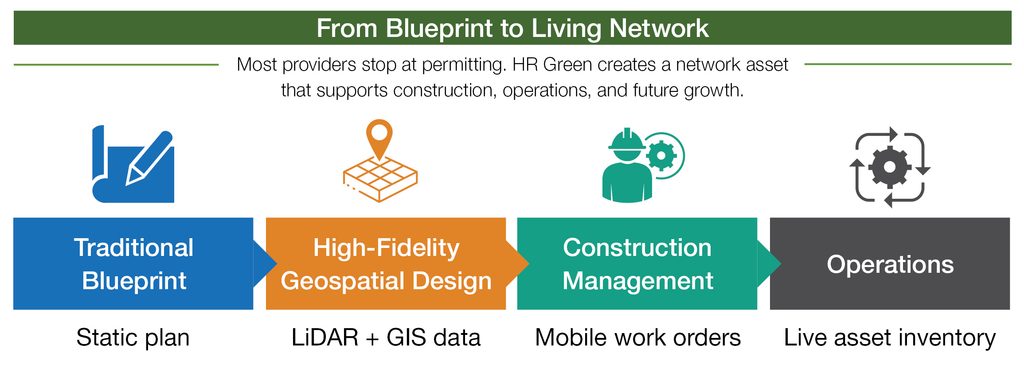
HR Green takes a different approach: integrating high-fidelity geospatial data from day one, so the design functions as an operational tool throughout deployment, not just a document that gets crews through permitting.
From Permitting to Operations: A Better Approach to Fiber Design
Most network engineering stops at the immediate goal: satisfy the municipality, get construction geometry approved, and move on. Geospatial design plans further out, toward the systems that will run the network for years after construction ends, including Business and Operations Support Systems.
Building in that deep asset attribution from the start means the design doubles as a long-term digital asset inventory, not just a construction plan that gets archived once the network is live.
Accurate Field Data for Faster Fiber Network Deployment

Flawed field data causes expensive problems downstream. HR Green uses state-of-the-art Mobile LiDAR and integrated imagery sensors capable of capturing 3.6 million pulses per second to prevent that.
On the Lehi City, Utah Fiber-to-the-Home project—a municipal fiber network built and operated by Strata Networks—this technology mapped every project roadway in a single mobile collection pass. HR Green then processed 200,000 feet of aerial and underground asset routing data per month, prioritizing cabinet areas for extraction. Instead of handing off a set of CAD drawings, the deliverable was structured GIS data that loaded directly into permitting software and deployment platforms.
Connecting Fiber Network Design to Construction Management
The geospatial design pays off most when it connects directly to construction management platforms like Render or Vitruvi, through a process called “Blueprinting.” Design data and construction parameters combine to break the network build into task-level work orders. This integration streamlines every stage of construction and closeout by:
- Providing field crews with construction-ready instructions on their mobile devices through an interactive map, eliminating the need for paper plans.
- Allowing office teams to track progress against project milestones using the same live data source available to field crews.
- Enabling crews to capture utility conflicts and as-built conditions in the field and send the information directly to operations for project closeout and payment processing.
That tighter loop lets ISPs assign crews by performance and cut the lag that comes from waiting on paperwork.
What are the Benefits of Geospatial Design for Fiber Deployment?
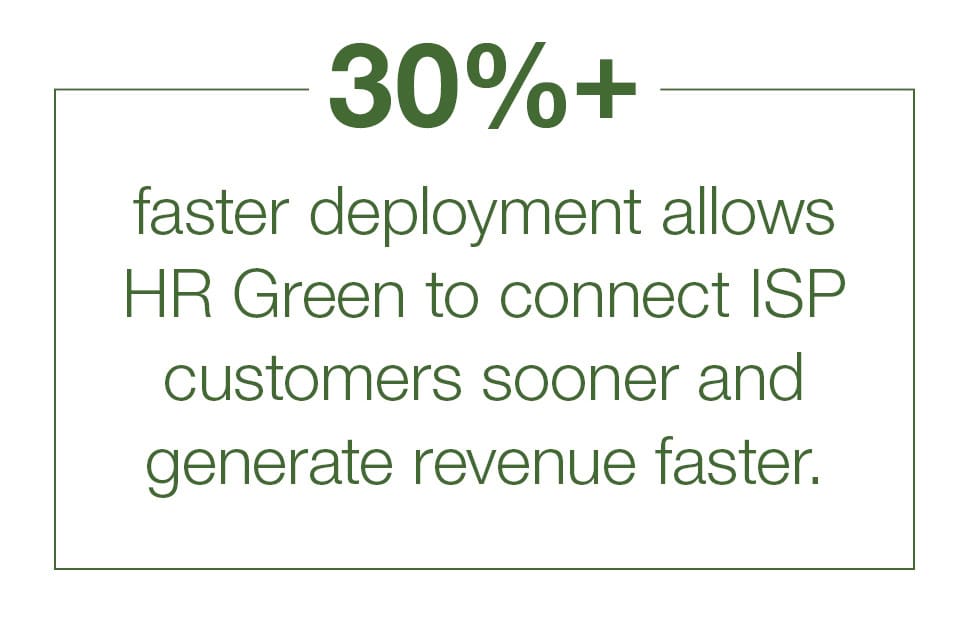
The Lehi City project shows what this looks like in practice: faster field mapping, cleaner handoffs to permitting, fewer return trips to the field. Across projects using this approach, HR Green has seen deployment run 30%+ faster, meaning ISPs connect customers sooner and start generating revenue faster.
A network design doesn’t have to end at permitting. Done right, it keeps working through construction, into operations, and all the way to the first subscriber connection.
Ready to scale your next broadband rollout? Connect with the HR Green Broadband and Geospatial teams to learn how we can optimize your deployment roadmap and accelerate your time-to-revenue.