
“When the well is dry, we know the worth of water.” – Benjamin Franklin
A potable water system is the infrastructure that collects, treats, stores, and distributes safe drinking water to a community. From source to tap, this process involves coordinated engineering, regulatory compliance, investment, and long-term planning to support reliability and public health.
Water is also unlike almost any other resource. It has no practical substitute, yet in many communities it remains relatively inexpensive compared with other necessities. That affordability can make reliable water service easy to take for granted.
The value of potable water extends far beyond the amount shown on a utility bill. It is fundamental to public health, economic activity, community growth, fire protection, manufacturing, agriculture, healthcare, and daily life. Protecting both the resource and the infrastructure that delivers it is becoming increasingly important as populations grow, systems age, and communities compete for finite supplies.
Starting at the Source: Where Does Drinking Water Come From?
Every potable water system begins with a source. Some communities rely on groundwater wells or well fields. Others draw from rivers, lakes, or reservoirs. Some purchase treated water from regional providers, while others operate blended systems that combine multiple sources to meet demand.
Each source presents distinct treatment requirements and operational considerations:
- Groundwater may require treatment for iron, manganese, hardness, nitrates, emerging contaminants, and disinfection before distribution.
- Surface water may need more extensive filtration, disinfection, and seasonal water-quality management.
- Purchased water can reduce treatment responsibilities but may create dependency on another provider’s capacity, rates, and infrastructure.
Communities also need to evaluate how their sources will perform over time. Population growth, drought, seasonal demand, industrial use, and changing environmental conditions can all affect supply. A source that meets today’s needs may not provide the same reliability decades from now.
That reality is particularly important because readily accessible freshwater is limited. Water may appear abundant, but only a small fraction of the planet’s total supply is easily accessible for human use. Unlike many commodities, water cannot be manufactured or replaced with a synthetic alternative when supply becomes constrained.
Protecting source water is therefore one of the most effective ways to preserve drinking water quality and manage future treatment needs. When contaminants enter a water source, communities may face years of monitoring, advanced treatment, source replacement, or restrictions on use. Groundwater can be especially slow to recover once depleted or contaminated; recharge can take decades, and pollutants can remain in an aquifer long after the original source is removed.
Land use, well protection, stormwater management, agriculture, development, industrial activity, conservation, and efficient water use can all influence the availability and quality of drinking water for future generations.uifer long after the original source is removed. Decisions involving land use, well protection, stormwater management, agriculture, development, and industrial activity can therefore affect drinking water availability for generations.
Treating Water for Safe Use
Once raw water is collected, it must be treated to meet drinking water standards and community expectations for taste, odor, clarity, and reliability.
Depending on source quality, common treatment processes include:
- Screening
- Aeration
- Filtration
- Softening
- Disinfection
- Membrane treatment
- Chemical feed systems
- Corrosion control
- Fluoridation
- Removal of iron, manganese, nitrates, or other contaminants
In some communities, treatment improvements may involve modernizing an existing facility. In others, they may require a new plant, new source, or updated technology to address pollutants of concern.
Treatment also illustrates why the cost of water cannot be viewed simply as the cost of the raw resource. Water may come from the ground, river, or reservoir, but making it safe and reliably available requires treatment facilities, pumps, storage, distribution systems, energy, chemicals, monitoring, skilled operators, and ongoing maintenance. of concern.
Emerging Contaminants: The PFAS Challenge
Emerging contaminants are changing treatment decisions. Per- and polyfluoroalkyl substances, commonly known as PFAS or “forever chemicals,” are synthetic compounds that resist natural breakdown and can accumulate in groundwater, surface water, soil, and living organisms. With federal drinking water limits established for several PFAS compounds, many communities are reevaluating source-water quality and existing treatment systems.
Conventional treatment methods are often not sufficient to remove PFAS effectively. Communities may need to consider granular activated carbon, ion exchange resins, reverse osmosis, or other advanced treatment systems. Engineers also use hydrogeologic modeling to evaluate how PFAS moves through groundwater, helping communities make informed decisions about source protection and treatment planning.
PFAS provides a clear example of why protecting water at its source matters. Once a persistent contaminant enters a supply, treatment can become more complex, operationally demanding, and costly. Preventing contamination can preserve both the resource and the infrastructure investments communities have already made.
Why Water Storage is Important
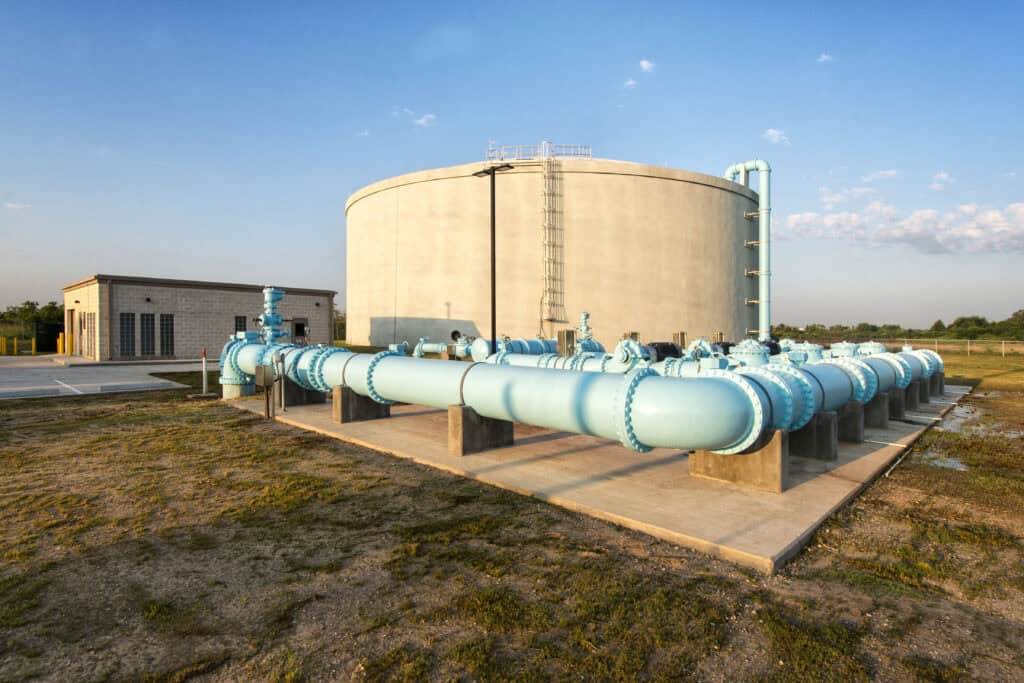
Water storage is a critical component of a potable water system. Elevated tanks, ground storage tanks, reservoirs, and clearwells help balance supply and demand while maintaining system pressure and operational flexibility.
Because water use varies throughout the day, storage allows systems to meet peak demands from household activity, irrigation, industrial use, and fire response without overburdening treatment and pumping facilities. Stored water also supports system resilience during maintenance, power outages, emergencies, or temporary interruptions in supply.
As communities grow, storage planning helps determine when additional capacity, rehabilitation, or new infrastructure is needed. Aging tanks require inspection, maintenance, coatings, and targeted improvements to extend service life and protect water quality.
Proper sizing and configuration matter. Too little storage can constrain growth and fire protection, while poorly configured storage can increase water age and reduce disinfectant residuals.
Moving Water Through the Community
After treatment and storage, potable water is delivered through a distribution system serving residential, commercial, institutional, and industrial users.
These systems must provide adequate pressure and reliable flow while maintaining water quality throughout the network. Appropriate pipe sizing, system looping, pressure control, and hydraulic modeling help utilities understand system performance and prepare for future demand.
In many communities, distribution improvements occur incrementally. Water main replacements and targeted system upgrades may be coordinated with roadway, utility, or development projects to reduce disruption and make the most effective use of available resources.
The value of this infrastructure is often most apparent when it stops working. A single major main break can interrupt homes and businesses, affect fire protection, close streets, and require an immediate emergency response. Reliable service depends on thousands of individual assets working together every hour of every day.
Addressing Aging Infrastructure
Many communities rely on potable water infrastructure that has been in service for decades, creating significant challenges as the industry enters what the American Water Works Association has described as a critical “Replacement Era.” Across the U.S. and Canada, water systems experience approximately 260,000 water main breaks each year, with annual repair costs estimated at $2.6 billion. In North America, that equates to roughly one water main break every two minutes; while aging and leaking pipes contribute to the loss of up to 6 billion gallons of treated drinking water every day. These losses waste not only water, but also the chemicals, energy, and labor required to treat and deliver it. (Source: ASCE)
Across the U.S. and Canada, water systems experience approximately 260,000 water main breaks each year, with annual repair costs estimated at $2.6 billion. In North America, that equates to roughly one water main break every two minutes, while aging and leaking pipes contribute to the loss of up to six billion gallons of treated drinking water every day. These losses waste not only water, but also the chemicals, energy, and labor required to treat and deliver it.
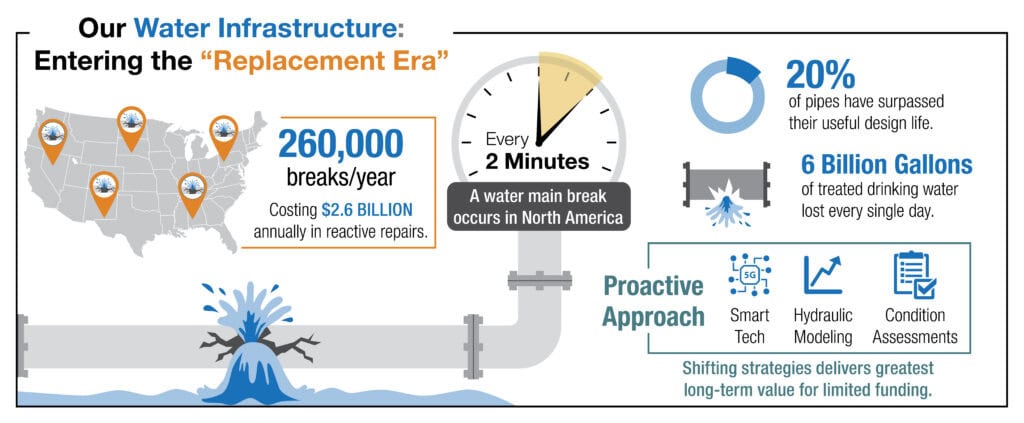
These challenges often develop gradually. Occasional water main breaks become recurring problems, water loss increases, and system components become more difficult to maintain. Approximately one-third of water mains are now more than 50 years old, and nearly 20 percent of water pipes have surpassed their useful design life but remain in operation.
One reason this challenge can be difficult for communities is that much of today’s water and wastewater infrastructure was originally built with substantial support from federal grants, appropriations, and other public funding sources. Rates established during those periods did not always reflect the full future cost of replacing and modernizing those systems.
As that infrastructure reaches the end of its service life, communities must confront the cost of sustaining the level of service residents have come to expect. Future rates, grants, loans, and capital programs will need to support not only daily operation, but also the rehabilitation and replacement of infrastructure that was built generations ago.
A proactive approach helps shift the focus from emergency repairs to strategic investment. Condition assessments and hydraulic modeling provide a clearer picture of system needs and help prioritize improvements, while smart water technologies can help utilities detect leaks and identify problems before they become larger failures.
Planning for Growth and Resilience
Potable water planning is not only about maintaining today’s system. It is also about preparing for tomorrow’s demand.
Drought, extreme weather, changing groundwater conditions, flooding, power interruptions, and source-water quality concerns can all affect reliability. Demand is also evolving in new ways. Rapid expansion of water-intensive development and industries, including data centers, can create concentrated demands that challenge municipal water and wastewater systems.
Population growth creates an equally important consideration. New homes, businesses, and industries require additional source capacity, treatment, storage, distribution, and wastewater treatment. Communities must consider not only whether water is available to support that growth, but also how the infrastructure required to serve it will be funded.
Reliable water is fundamental to economic development. Manufacturing, healthcare, education, agriculture, housing, hospitality, and emergency services all depend on adequate water quantity and quality. A community’s ability to attract growth is closely connected to its ability to provide dependable water and wastewater service.
At the same time, communities cannot rely solely on finding new supplies. Conservation and efficient water use will increasingly be part of meeting future demand. Reducing leakage, improving irrigation efficiency, managing peak use, deploying advanced metering, and matching water quality to its intended use can help communities make existing supplies go further.
Expanding the Water Supply Portfolio
Where traditional supplies are constrained, communities are increasingly considering reclaimed water, potable reuse, and desalination to diversify sources and reduce pressure on groundwater and surface water.
Reclaimed water is highly treated municipal wastewater repurposed for non-drinking uses such as irrigation and industrial cooling. Every gallon used for these purposes preserves potable water for uses that require drinking-water quality.
Indirect potable reuse introduces highly treated water into an environmental buffer such as a groundwater aquifer or surface reservoir before it is extracted and treated again for drinking.
Direct potable reuse introduces highly purified water into the drinking-water supply without an environmental buffer. Treatment can include microfiltration or ultrafiltration, reverse osmosis, and advanced oxidation to remove contaminants and provide a highly controlled source of supply.
These approaches reflect an important shift in water planning: communities are increasingly viewing water as a resource to be managed throughout its entire cycle rather than used once and discharged.
Beyond Traditional Supply: Reuse and Desalination
Desalination offers another option in coastal regions or areas with brackish groundwater. Globally, roughly 22,000 operational desalination plants across 177 countries generate an estimated 95 million cubic meters of fresh water per day and serve more than 300 million people. In the United States, more than 400 municipal desalination plants operate in states such as Arizona, California, Florida, and Texas. (Source: IDRA)
There are two primary desalination methods:
- Membrane-based systems, primarily reverse osmosis, force source water through semipermeable membranes that remove salts, minerals, and other dissolved substances; this method is highly adaptable and used for both seawater and brackish groundwater.
- Thermal-based systems, or distillation, heat saltwater to produce steam, leaving salts and minerals behind, then capture and condense the steam into fresh water—more common in regions with abundant, low-cost energy.
Both approaches can provide a supply source that is largely independent of rainfall and surface-water conditions, an important consideration as climate variability increases pressure on traditional sources.
Using Data to Make Better Decisions
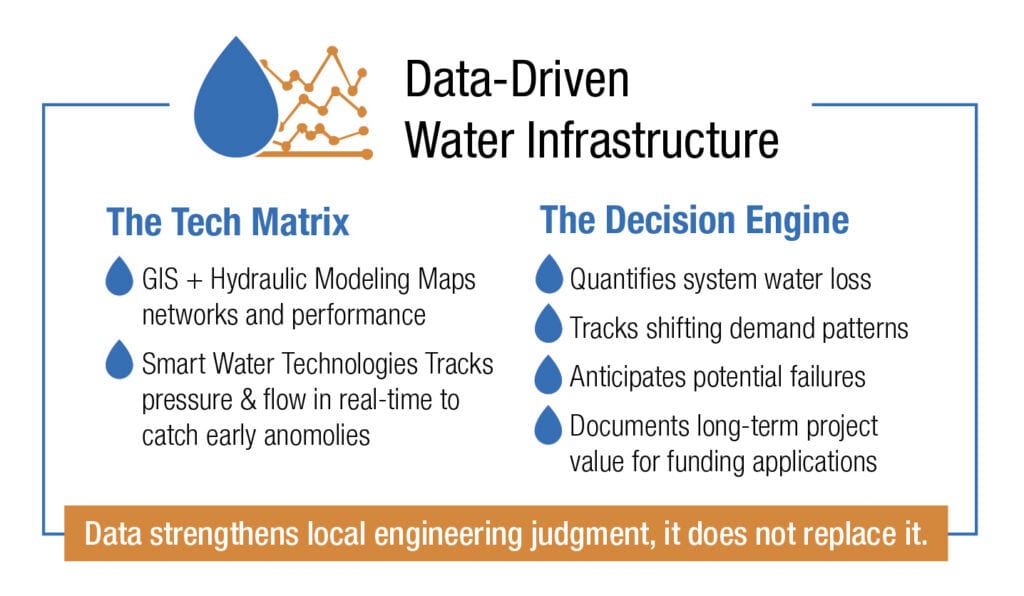
Modern potable water planning is increasingly data-driven, giving communities better tools to understand system performance, identify vulnerabilities, and prioritize investment.
Hydraulic modeling, GIS mapping, and asset data work together to show how water moves through the network, where infrastructure is located, and how it has performed over time. These insights help quantify water loss, track demand patterns, and support more informed planning and operations.
Smart water technologies extend these capabilities by allowing utilities to monitor pressure, flow, and water quality, identify anomalies earlier, and anticipate potential failures before they disrupt service.
Pilot studies can help communities manage those investments by testing treatment approaches on a smaller scale before full implementation. This provides better information about treatment performance, operating requirements, and lifecycle considerations before major improvements move forward.
Supporting Affordability While Recognizing Water’s Value
Potable water projects are community investments funded through ratepayers, taxpayers, grants, loans, and public budgets. Affordability matters, particularly because access to safe drinking water is fundamental to everyday life.
At the same time, low rates can unintentionally obscure what it takes to provide reliable water service.
According to U.S. EPA WaterSense data, the average production cost for residential potable water is $7.74 per 1,000 gallons, while commercial water averages $6.13 per 1,000 gallons. Combined residential water and wastewater treatment costs average $16.83 per 1,000 gallons.
Viewed by volume, that remains remarkably inexpensive for a resource communities cannot function without.
The economic value of water therefore goes beyond its price. Rates must ultimately support the infrastructure, people, energy, treatment, monitoring, and maintenance necessary to deliver safe water around the clock. As systems age and communities grow, sustainable water service will require continued investment and rate structures capable of supporting both current operations and future infrastructure needs.
Protecting a Resource Communities Depend On
The decisions communities make about potable water today will shape their ability to grow and thrive for decades. Water is a finite resource with no substitute. Protecting its sources, reducing unnecessary losses, investing in aging infrastructure, using water efficiently, and planning responsibly for future growth all contribute to long-term water security.
Communities should look for a partner with:
- Depth across the full project lifecycle: from source evaluation, system planning, and hydraulic modeling through treatment design, construction administration, and SCADA integration.
- Funding knowledge: navigating State Revolving Funds, federal grants, loans, and other programs can help communities structure infrastructure investments responsibly.
- Regulatory fluency: drinking water requirements, environmental regulations, funding conditions, and permitting processes are increasingly complex.
- A source-to-tap perspective: effective planning considers not only treatment, but also source protection, storage, distribution, water quality, conservation, resilience, and long-term demand.
Ultimately, the value of water is not defined by what it costs today. It is defined by what safe, reliable water makes possible—and what happens when it is no longer readily available. Protecting that resource, and investing in the infrastructure that delivers it, is fundamental to the health, resilience, and economic future of every community.
From small communities developing new water systems to major metropolitan facilities serving tens of thousands of residents, HR Green delivers the technical expertise and integrated services needed to support safe, reliable potable water from source to tap. Ready to strengthen your water system and plan for the future? Connect with HR Green to develop practical, sustainable solutions that protect water quality, enhance reliability, and meet your community’s evolving needs.