
A potable water system is the infrastructure that collects, treats, stores, and distributes safe drinking water to a community. From source to tap, this process involves coordinated engineering, regulatory compliance, and long-term planning to support reliability and public health.
Potable water has no practical substitute. Communities can conserve it, reuse water for non-drinking purposes, or develop alternative sources, but homes, schools, businesses, and emergency services still depend on a reliable supply of safe water every day. That makes protecting water quality and availability one of the most important long-term responsibilities a community faces.
Starting at the Source: Where Does Drinking Water Come From?
Every potable water system begins with a source. Some communities rely on groundwater wells or well fields. Others draw from rivers, lakes, or reservoirs. Some purchase treated water from regional providers, while others operate blended systems that combine multiple sources to meet demand.
Each water source type presents distinct treatment requirements and operational considerations:
- Groundwater may require treatment for iron, manganese, hardness, nitrates, or emerging contaminants and disinfection prior to distribution.
- Surface water may need more extensive filtration, disinfection, and seasonal water quality management.
- Purchased water can reduce treatment responsibilities but may create dependency on another provider’s capacity, rates, and infrastructure.
Communities also need to evaluate how their water sources will perform over time. Population growth, drought, seasonal demand, industrial use, and changing environmental conditions can all affect supply. A source that meets today’s needs may not provide the same reliability years from now.
Protecting source water is often one of the most effective ways to preserve drinking water quality and manage treatment costs. When contaminants enter a water source, communities may face years of monitoring, advanced treatment, source replacement, or restrictions on use. Groundwater in particular can be slow to recover once depleted or contaminated—recharge can take decades, and pollutants can remain in an aquifer long after the original source is removed. Decisions involving land use, well protection, stormwater management, agriculture, development, and industrial activity can therefore affect drinking water availability for generations.
Treating Water for Safe Use
Once raw water is collected, it must be treated to meet drinking water standards and community expectations for taste, odor, clarity, and reliability.
Common treatment processes include:
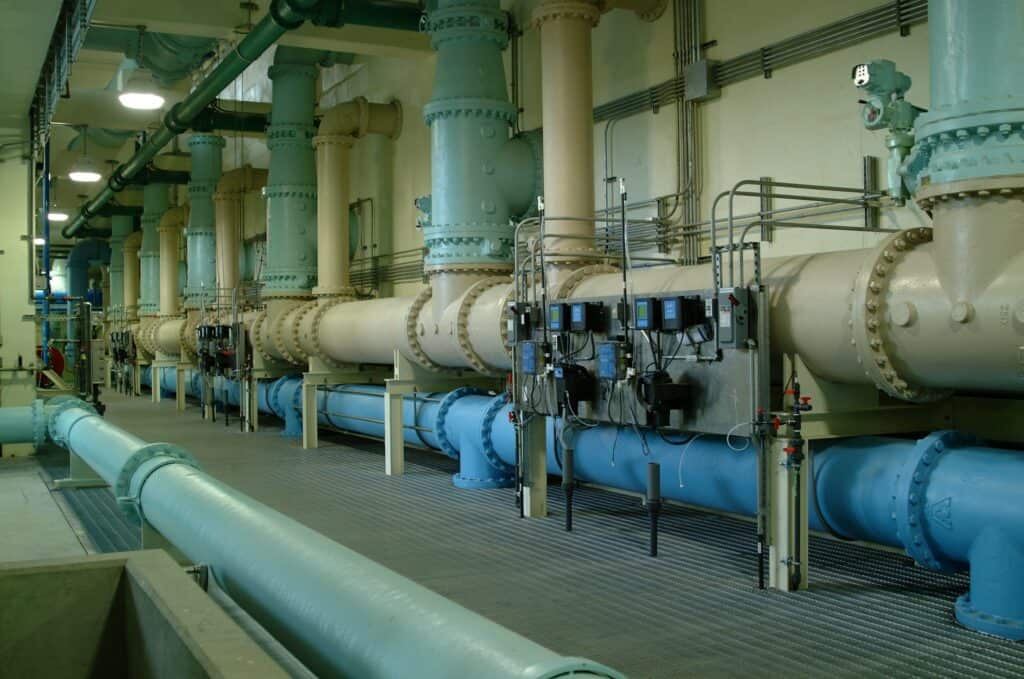
- Screening
- Aeration
- Filtration
- Softening
- Disinfection
- Membrane treatment
- Chemical feed systems
- Corrosion control
- Fluoridation
- Removal of iron, manganese, nitrates, or other contaminants
In some communities, treatment improvements may involve modernizing an existing facility. In others, they may require a new plant, a new source, or updated technology to address new pollutants of concern.
Emerging Contaminants: The PFAS Challenge
Emerging contaminants are also changing treatment decisions. Per- and polyfluoroalkyl substances, commonly known as PFAS or “forever chemicals,” are synthetic compounds that resist natural breakdown and can accumulate in groundwater, surface water, soil, and living organisms. With the U.S. Environmental Protection Agency’s 2024 drinking water limits for several PFAS compounds, many communities are reevaluating source water quality and existing treatment systems.
Conventional treatment methods are often not sufficient to remove PFAS effectively. Communities may need to consider granular activated carbon, ion exchange resins, reverse osmosis, or other advanced treatment systems. Engineers also use hydrogeologic modeling to evaluate how PFAS moves through groundwater, helping communities make informed decisions about source protection and treatment planning.
PFAS is a clear illustration of why protecting source water matters in the first place: once a persistent contaminant enters a supply, treatment becomes more complex, expensive, and operationally demanding.
Why Water Storage is Important
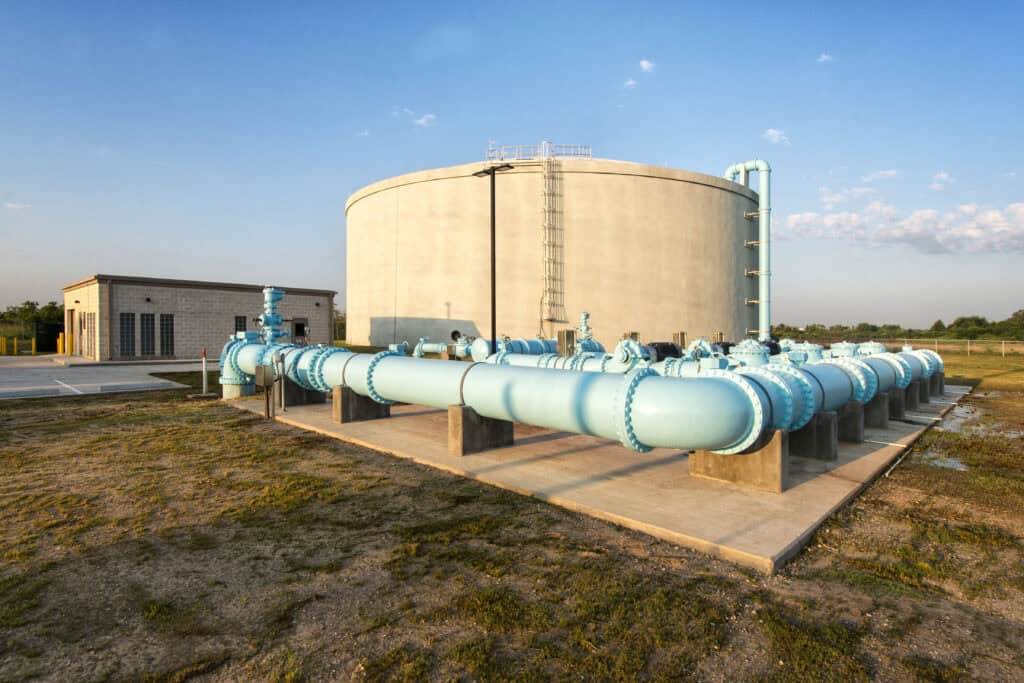
Water storage is a critical component of a potable water system. Elevated tanks, ground storage tanks, reservoirs, and clearwells help balance supply and demand while maintaining system pressure and operational flexibility.
Because water use varies throughout the day, storage allows systems to meet peak demands from household activity, irrigation, industrial use, and fire response without overburdening treatment and pumping facilities. Stored water also supports system resilience during maintenance, power outages, or emergencies.
As communities grow, storage planning helps determine when additional capacity, rehabilitation, or new infrastructure is needed. Aging tanks also require inspection, maintenance, coatings, and targeted improvements to extend service life and protect water quality. Proper sizing and configuration matter: too little storage can limit growth and fire protection, while poorly configured storage can increase water age and reduce disinfectant residuals.
Moving Water Through the Community
After treatment and storage, potable water is delivered through a distribution system serving residential, commercial, institutional, and industrial users.
These systems must provide adequate pressure and reliable flow while maintaining water quality throughout the network. Thoughtful design, supported by appropriate pipe sizing, system looping, and pressure control, helps improve reliability and minimize service disruptions. Hydraulic modeling helps communities evaluate performance and plan for future demand as part of this work (more on that below).
In many communities, distribution system upgrades occur incrementally. Improvements such as water main replacement or targeted system upgrades are often coordinated with other infrastructure or development projects to reduce disruption and maximize available funding.
Addressing Aging Infrastructure
Many communities rely on potable water infrastructure that has been in service for decades, creating significant challenges as the industry enters what the American Water Works Association has described as a critical “Replacement Era.” Across the U.S. and Canada, water systems experience approximately 260,000 water main breaks each year, with annual repair costs estimated at $2.6 billion. In North America, that equates to roughly one water main break every two minutes; while aging and leaking pipes contribute to the loss of up to 6 billion gallons of treated drinking water every day. These losses waste not only water, but also the chemicals, energy, and labor required to treat and deliver it. (Source: ASCE)
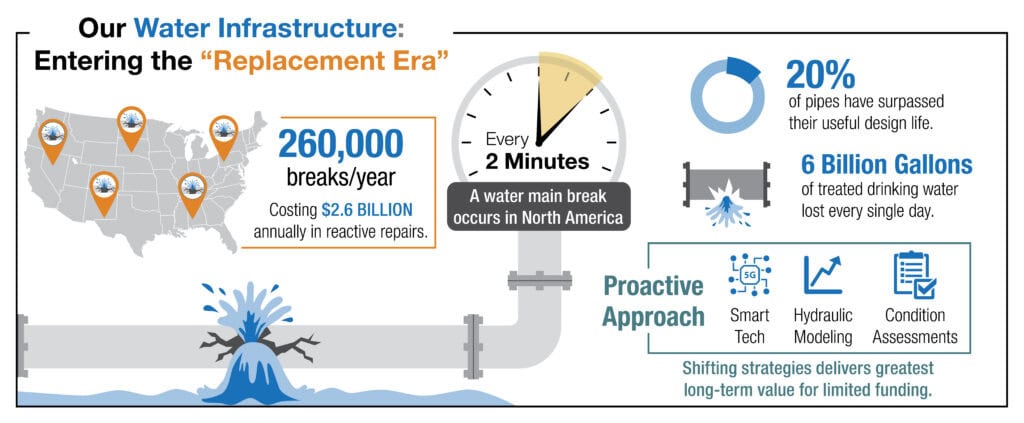
These challenges often develop gradually: occasional water main breaks become recurring problems, water loss increases, and system components grow more difficult to maintain. Approximately one-third of water mains are now more than 50 years old, and nearly 20 percent of water pipes have surpassed their useful design life but remain in operation. Storage and treatment facilities may also require rehabilitation, development pressures can expose capacity constraints, and evolving regulations may necessitate new processes or monitoring.
A proactive approach helps shift the focus from reactive repairs to strategic investment. Condition assessments and hydraulic modeling provide a clearer understanding of system needs and help prioritize improvements over time, while smart water technologies increasingly help utilities detect leaks and identify issues before they escalate into failures. This type of planning is especially critical when funding is constrained and communities must focus on investments that deliver the greatest long-term value.
Planning for Growth and Resilience
Potable water planning is not only about maintaining today’s system. It is also about preparing for tomorrow’s demand.
Drought, extreme weather, changing groundwater conditions, flooding, power interruptions, and source-water quality concerns can all affect potable water reliability. Demand is also evolving in unexpected ways. The rapid expansion of AI data centers, for example, can create intense, localized water demands that stress municipal supply and wastewater systems in ways that traditional planning models did not anticipate.
Reliable potable water is also essential to economic stability. Manufacturing, healthcare, education, agriculture, and emergency services all depend on adequate water quantity and quality. Communities that protect their sources and maintain dependable infrastructure are better positioned to support growth and respond to future demands.
Where traditional supplies are constrained, communities are increasingly looking at reclaimed water, potable reuse, and desalination to diversify sources and reduce pressure on groundwater and surface water. These represent three primary approaches, each reflecting a different level of treatment and integration into the drinking water supply.
Reclaimed water is highly treated municipal wastewater repurposed for non-drinking uses such as irrigation, industrial cooling, or other applications. Every gallon used for these purposes preserves a gallon of drinking water supply, helping protect aquifer levels and reduce strain on treatment facilities. In communities where dual-plumbing infrastructure is in place, reclaimed water travels through dedicated distribution networks, commonly identified by purple pipe, entirely separate from the potable system.
Indirect potable reuse takes purification further by introducing treated water into an environmental buffer such as a groundwater aquifer or surface reservoir, where it blends with natural water before being extracted and treated again for drinking. This environmental step provides an additional layer of treatment and public confidence before the water re-enters the supply.
Direct potable reuse introduces highly purified water into the distribution system or raw-water supply without an environmental buffer. Both indirect and direct systems rely on a multi-stage purification process that may include microfiltration or ultrafiltration, reverse osmosis to remove dissolved contaminants, viruses, and pharmaceuticals, and an advanced oxidation process using ultraviolet light or ozone to address remaining trace compounds. These systems are tightly monitored and must meet applicable drinking water standards.
Beyond Traditional Supply: Reuse and Desalination
Desalination offers another option in coastal regions or areas with brackish groundwater. Globally, roughly 22,000 operational desalination plants across 177 countries generate an estimated 95 million cubic meters of fresh water per day and serve more than 300 million people. In the United States, more than 400 municipal desalination plants operate in states such as Arizona, California, Florida, and Texas. (Source: IDRA)
There are two primary desalination methods:
- Membrane-based systems, primarily reverse osmosis, force source water through semipermeable membranes that remove salts, minerals, and other dissolved substances; this method is highly adaptable and used for both seawater and brackish groundwater.
- Thermal-based systems, or distillation, heat saltwater to produce steam, leaving salts and minerals behind, then capture and condense the steam into fresh water—more common in regions with abundant, low-cost energy.
Both approaches can provide a supply source that is largely independent of rainfall and surface-water conditions, an important consideration as climate variability increases pressure on traditional sources.
Using Data to Make Better Decisions
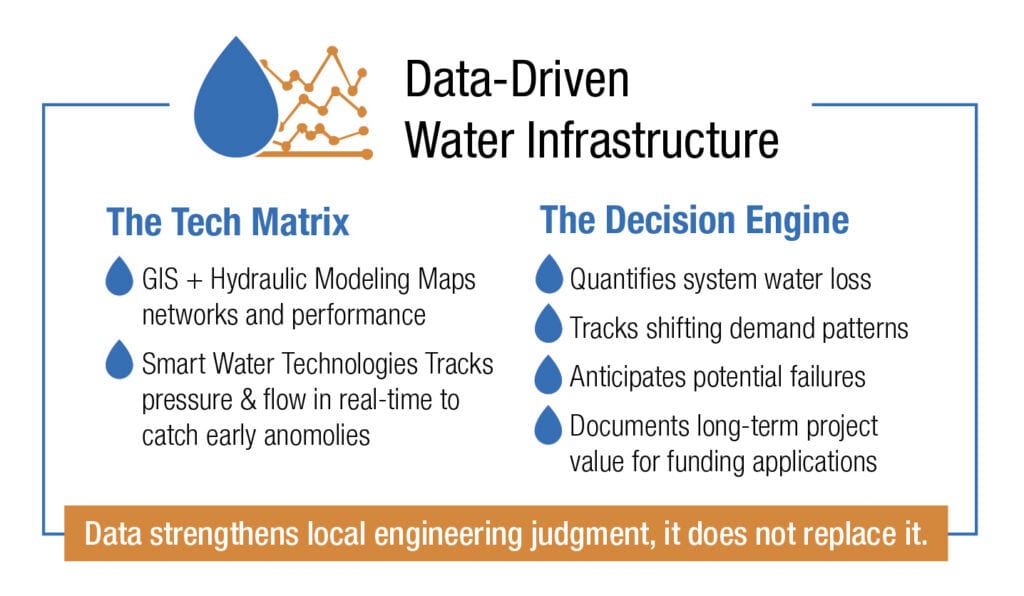
Modern potable water planning is increasingly data-driven, giving communities better tools to understand system performance, identify vulnerabilities, and prioritize investments.
Hydraulic modeling, GIS mapping, and asset data work together to provide a clearer picture of system conditions: how water moves through the network, where infrastructure is located, and how it has performed over time. These insights help quantify water loss, track demand patterns, and support more informed planning and operations. Smart water technologies extend this further, allowing utilities to monitor pressure, flow, and water quality in real time, identify anomalies earlier, and anticipate potential failures before they disrupt service.
Together, these capabilities improve visibility and support stronger decision-making. They also enhance funding applications by clearly documenting system needs, project benefits, and long-term value. Data does not replace engineering judgment or local knowledge, but it strengthens decision-making by providing a more reliable foundation for maintenance planning, capital improvements, system upgrades, source protection, and future growth.
Supporting Affordability and Long-Term Value
Potable water projects are not only technical projects; they are community investments funded by ratepayers, taxpayers, grants, loans, and public budgets. That is why affordability must be considered alongside performance. Communities need solutions that meet regulatory requirements and service goals without creating unnecessary financial strain.
Cost considerations can vary significantly depending on the raw water source, treatment requirements, regulatory standards, energy costs, and the condition of local infrastructure. According to the US EPA, the average production cost for residential potable water is $7.74 per 1,000 gallons, while commercial water averages $6.13 per 1,000 gallons; combined water and wastewater treatment costs average $16.83 per 1,000 gallons for residential users. (Source: EPA WaterSense data)
Pilot studies can play an important role in managing these decisions. Testing treatment approaches on a smaller scale before full implementation can help communities better understand process performance, operational requirements, and cost considerations before committing to major capital improvements.
Protecting a Resource Communities Depend On
Potable water projects are long-term commitments. The decisions made in a planning study today will shape how a community’s water system performs for the next 20 to 50 years.
Communities should look for a partner with:
- Depth across the full project lifecycle: from source evaluation, system planning, and hydraulic modeling through treatment design, construction administration, and SCADA integration.
- Funding knowledge: many potable water projects qualify for State Revolving Funds, federal grants, and other programs that can reduce the burden on local ratepayers.
- Regulatory fluency: drinking water requirements, environmental regulations, funding conditions, and permitting processes are layered and complex.
- A source-to-tap perspective: effective planning must consider not only treatment, but also source protection, storage, distribution, water quality, resilience, and long-term demand.
HR Green brings these capabilities to potable water engagements ranging from small communities building their first distribution systems to major metropolitan treatment plants serving tens of thousands of residents. The goal is always the same: water that is safe, reliable, resilient, and trusted by the people who depend on it every day.
Ready to strengthen your potable water system? Connect with HR Green to start planning improvements that support safe, reliable water from source to tap.