
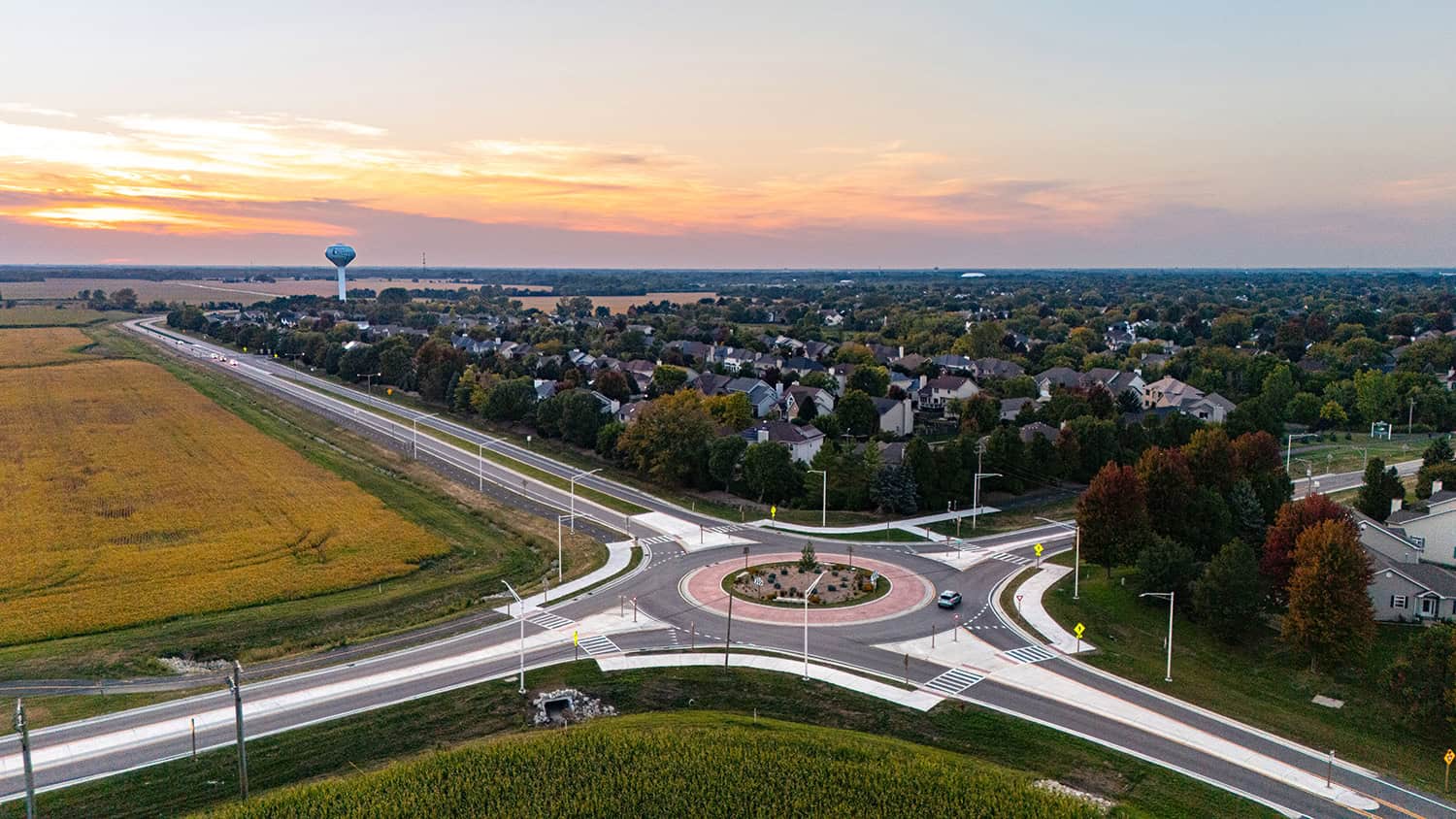
Roundabouts have become a widely adopted intersection tool because they directly target the outcomes transportation agencies care about most: fewer crashes, more predictable traffic flow, and long-term operational resilience. The Federal Highway Administration (FHWA) lists roundabouts as a “Proven Safety Countermeasure” and notes that they can improve safety, promote lower speeds, reduce conflict points, and improve operational performance across a wide range of traffic conditions. Roundabouts are also versatile in size, shape, and design, which makes them applicable in urban corridors, rural highways, and interchange terminals.
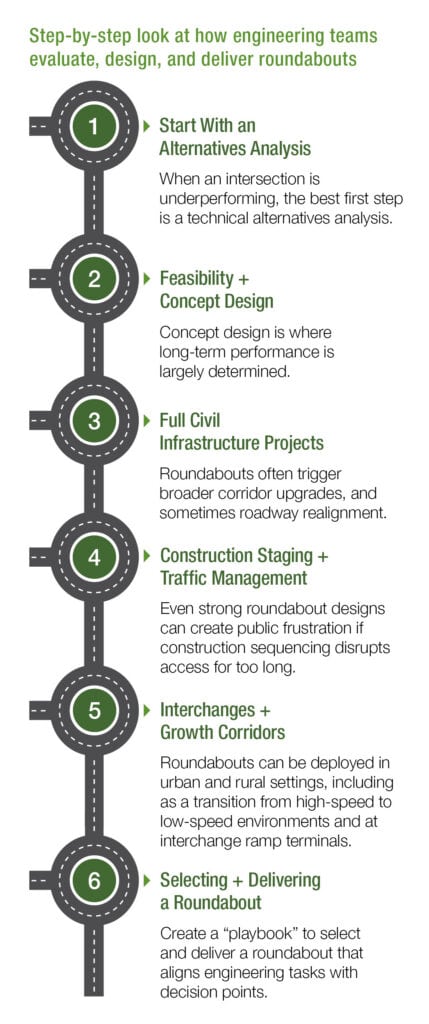
Below is a step‑by‑step look at how engineering teams evaluate, design, and deliver roundabouts—and what an agency can expect at each stage—supported by lessons from HR Green’s real‑world projects.
1) Start With an Alternatives Analysis
When an intersection is underperforming due to substandard geometrics, crash history, queuing, speeding, turning conflicts, or development-driven growth, the best first step is a technical alternatives analysis, including:
- Traffic volumes and turning movements for key periods, plus heavy vehicle percentage and seasonal considerations.
- Crash history and crash type, including patterns, severity, and mitigation strategies that reduce “T-bone” collisions.
- Queue observations and delays, which are particularly important when evaluating oddly shaped intersections like 5‑way stops.
- Corridor context such as school routes, trail crossings, or transit stops.
- Right-of-way and geometric constraints like angles, grades or sight restrictions.
- Utilities and drainage, including storm sewer capacity, floodplain constraints, ditches, or culverts.
- Pedestrian and bicycle demand.
Planning-stage cost considerations are central at this stage. Roundabouts are sometimes a bit higher on upfront construction cost, but they can reduce long-term maintenance exposure by eliminating signal hardware and timing system upkeep. Space is also part of cost: a roundabout footprint is often larger than a typical signalized intersection, and that may mean additional right-of-way acquisition or easements, requiring early coordination with property owners to protect access and keep schedules predictable, as well as coordination with utility relocation.
The safety rationale behind roundabouts is more than “slower speeds.” It is about changing the conflict environment and managing speeds. FHWA’s Roundabouts Informational Guide illustrates how a conventional four-leg intersection has 32 vehicle-to-vehicle conflict points, while a single-lane roundabout reduces that to eight. Roundabout conversions are consistently associated with large reductions in severe crashes.
Multimodal considerations should be evaluated up front, especially at intersections with high pedestrian and cyclist activity. Lower operating speeds and one-way circulating traffic simplify the crossing task and can improve pedestrian safety and comfort.
Environmental performance is also part of alternatives analysis. By reducing full stops and long queues in many contexts, roundabouts can reduce vehicle idling compared with signal control, an operational benefit that also supports air quality goals.
2) Feasibility and Concept Design
Once a roundabout is shortlisted, concept design is where long-term performance is largely determined. A roundabout is not simply a circular curb; it’s a speed-managed geometry with a specific operating logic: yield-at-entry, deflection, and low circulating speeds.
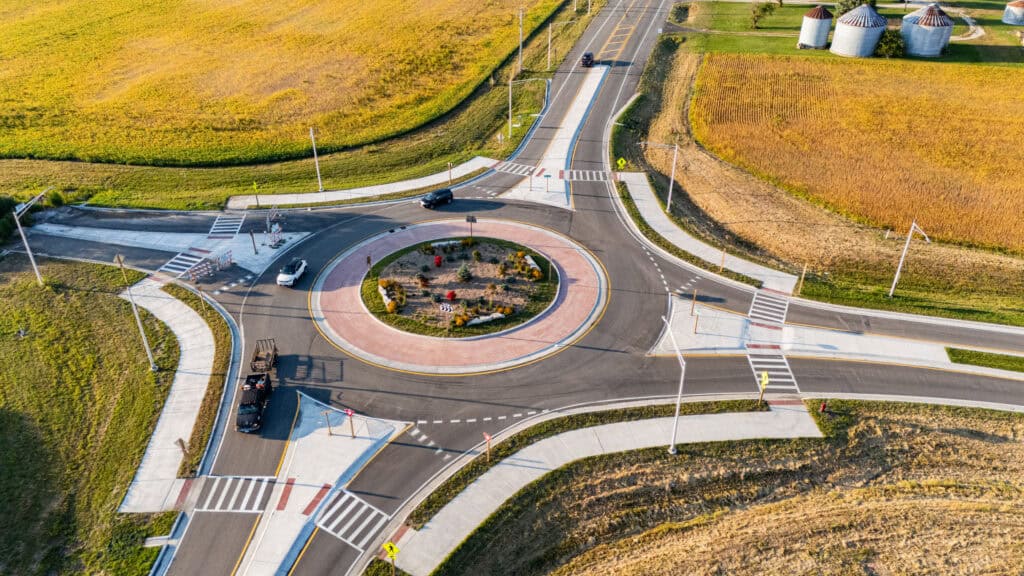
Key concept-level elements include:
- Inscribed circle diameter must balance speed control, truck turning, and right-of-way impacts.
- Entry geometry is the primary driver of entry speed and capacity.
- Circulatory roadway width must accommodate vehicles without encouraging excessive speed.
- Truck apron width and cross slope accommodate oversized vehicles while discouraging passenger car encroachment.
- Pedestrian crossing placement to reduce vehicle-pedestrian conflict.
- Capacity analysis to determine the appropriate number of entering, exiting, and circulating lanes.
- Sight distance analysis to ensure appropriate viewing angles downstream for pedestrians and motorists.
Roundabout design is inherently iterative. At concept, engineers cycle through geometry refinements—often multiple times—to balance safety, capacity, and footprint. A central objective is speed control and consistency through the approaches, entries, and circulating roadway. In many cases, the target operating range is roughly 15–25 mph, using geometric deflection and entry design to slow vehicle speed rather than posted signs alone.
At this stage, our engineers run design vehicle checks to confirm that emergency vehicles, snowplows, freight, and even farm implements can navigate the intersection without compromising speed control for passenger vehicles.
Approach channelization is another make-or-break factor. As drivers approach, the design should guide them smoothly into the correct path, so movements are intuitive and decision points are clear.

The pedestrian and bicycle accommodations strategy is also finalized here, not added later. Many designs incorporate a side path around the roundabout with refuge areas that make crossings shorter, more predictable, and more visible to motorists.
3) Where Roundabouts Become “Full Civil Infrastructure Projects”
Roundabouts often trigger broader corridor upgrades—drainage, lighting, sidewalks, utilities, right-of-way, and sometimes roadway realignment. Detailed design is where municipalities protect long-term maintainability and make sure the roundabout functions in all seasons and under real traffic patterns. Accommodating a roundabout’s central island, splitter islands, and approaches requires new drainage plans.
A practical example is Kendall County’s Collins Road Extension, where intersection improvements weren’t just geometric—they were integrated with major drainage upgrades. The project addressed chronic flooding at the Grove Road/Collins Road intersection with new deeper ditches and an 8’ x 4’ precast box culvert, while also constructing two new roundabouts as part of broader corridor improvements. The result is a safer, more reliable corridor that reduces flood-related access problems and improves mobility for a growing county.
Multimodal design is also finalized in detailed design, including ADA-compliant crossings with detectable warnings, refuge geometry, sidewalk connections that match desire lines, and lighting placement that supports nighttime visibility. Bicycle accommodation strategy is confirmed based on posted speed, volumes, and expected rider profile, with options ranging from shared-lane operation in low-speed environments to separated shared-use paths with ramps and transitions where appropriate.
Utilities and right-of-way are typically refined in this phase as well. Modern roundabouts can require additional right-of-way or easements to fit the footprint and to resolve grading, drainage, or utility conflicts. The Granart Road and Dugan Road realignment in the Village of Sugar Grove is an example of a roundabout delivered under tight constraints where detailed design had to account for access to multiple businesses, complex staging, and a major utility conflict—a 30-inch high-pressure gas main crossing the alignment within a protected easement. The design team adjusted roadway, ditch, and storm sewer profiles to meet minimum cover requirements without compromising safety or performance, while also preparing plats, legal descriptions, and land acquisition exhibits to keep the project on schedule.
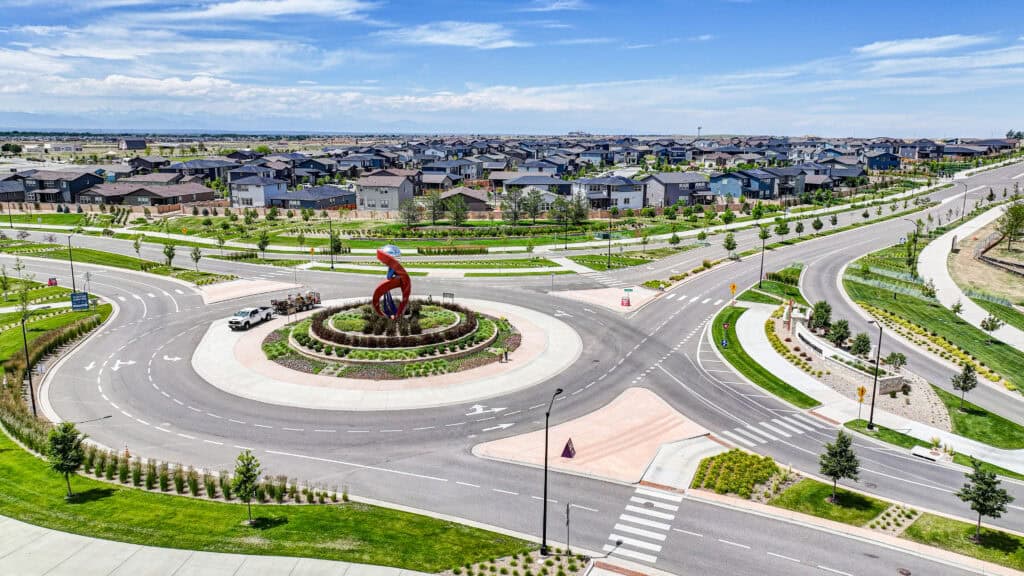
Landscaping and aesthetics are also an important aspect in final design. The landscaping in and around a roundabout can help create traffic calming effects and can help to serve as a community touchstone. This can be exemplified by The Aurora Highlands project in Colorado that HR Green completed—truly a gateway to the community and a site to behold.
4) Construction Staging and Traffic Management
Even strong roundabout designs can create public frustration if construction sequencing disrupts access for too long or creates confusing temporary patterns. Municipalities benefit when engineers treat staging as a core design product rather than an afterthought.
Common staging approaches include:
- Full detour with local access maintained: often best for schedule and safety; helpful in final phase to quickly complete the project.
- Partial detours with split traffic patterns: when detours are impractical; may add time to the project with additional traffic/construction stages.
- Temporary pavement and phased tie-ins: when businesses or emergency access must remain open.
Sugar Grove’s project required a staging approach where 75% of the roundabout was built “offline” of the existing roadway, where traffic was not affected, and the last portion required a full closure with temporary access to local businesses.
Public education is also a critical construction-phase companion. Because roundabouts change driver expectations—especially when converting from a four-way stop or a signal—proactive communication helps reduce confusion at opening. Clear dynamic messaging (message boards) or educational outreach around yielding, lane use, pedestrian crossings, truck apron function, and detour routing can meaningfully improve first-week operations. For the Sugar Grove project, open house meetings with engineers and public works were held to support this outreach. HR Green supports our clients with public involvement approaches that prioritize clarity and two-way communication, so residents understand what’s changing and why.
5) Where Roundabouts Fit Particularly Well: Interchanges and Growth Corridors
Roundabouts can be deployed in urban and rural settings, including as a transition from high-speed to low-speed environments and at interchange ramp terminals.
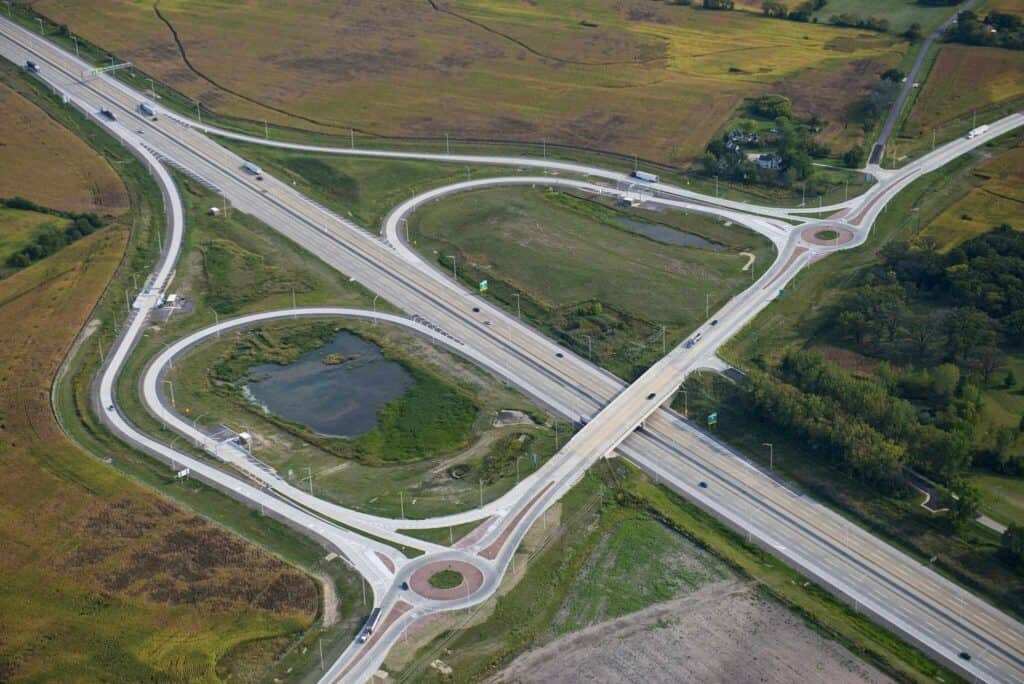
A strong example is the I-90/IL-23 Interchange in Marengo, which used roundabouts at ramp terminals to manage flows safely and efficiently at McHenry County’s first interstate connection, closing a 17-mile gap between interchanges. The design improved access and positioned the corridor for economic growth by creating a safer, more legible interchange terminal configuration.
The interchange use case is compelling because ramp terminals often face competing needs: peak surges, heavy trucks, and safety risks from high-speed approaches. Roundabouts provide speed transition and reduce conflict severity without relying on signal power and timing—an important resilience advantage.
Roundabouts also make excellent entries to new developments or residential subdivisions. The traffic calming effects and aesthetic benefits can create a pleasing entry for residents that helps promote a sense of place and belonging.
6) A Practical “Playbook” for Selecting and Delivering a Roundabout
If your agency is considering a roundabout, here’s a highly practical sequence that aligns engineering tasks with decision points:
- Define the outcome problem
Is the primary issue severe crashes, peak queuing, speeding, school crossing risk, development traffic, flood-related shutdowns, or all the above? - Perform alternatives analysis with transparent criteria
Compare stop control, signalization, geometric reconfiguration, and roundabout control using safety, capacity, right-of-way impacts, utility impacts, and cost as a guide. - Advance concept geometry and confirm feasibility
Run turning paths, speed checks, and concept operations. Identify right-of-way “pressure points” early. - Confirm multimodal strategy
Decide how pedestrians and bicycles will be handled and confirm ADA approaches and refuge needs. - Develop detailed plans, specifications, and estimates with constructability in mind
Integrate drainage, utilities, lighting, signing/markings, staging, and permitting. For corridor projects, confirm network impacts. - Plan staging and public communications as part of design
Reputations are made here. Provide clear detour logic and business access plans. - Post-opening field review
After opening, evaluate signing visibility, truck paths, and any friction points like oversize moves. Address issues early rather than letting issues linger.
Roundabouts are not a one-size-fits-all solution, but they are highly adaptable when selected through a rigorous alternatives analysis and designed around real vehicles, multimodal needs, and constructability. The strongest outcomes happen when roundabouts are integrated into a broader corridor strategy, often combining safety improvements, drainage performance, and long-term growth readiness, while delivering measurable benefits for residents and commuters who use the intersection every day.
Explore how HR Green can support your next intersection or corridor upgrade—reach out to our transportation team for help navigating analysis, design, and constructability.