

Civil engineering firms are often selected based on technical qualifications, project experience, and the ability to deliver complex infrastructure solutions. Those capabilities matter. But the firms that become long-term partners bring something more.
Public agencies face competing demands, including limited budgets, staffing shortages, evolving regulations, political priorities, aging infrastructure, and unexpected emergencies. Consultants who recognize those realities and guide agencies through them provide greater value than those who simply respond to the task at hand. That value is not built on a single project. It is built through consistent behavior over time, in how a firm listens, communicates, and shows up when things get difficult.
Understand Agency Goals Before Solving Infrastructure Challenges
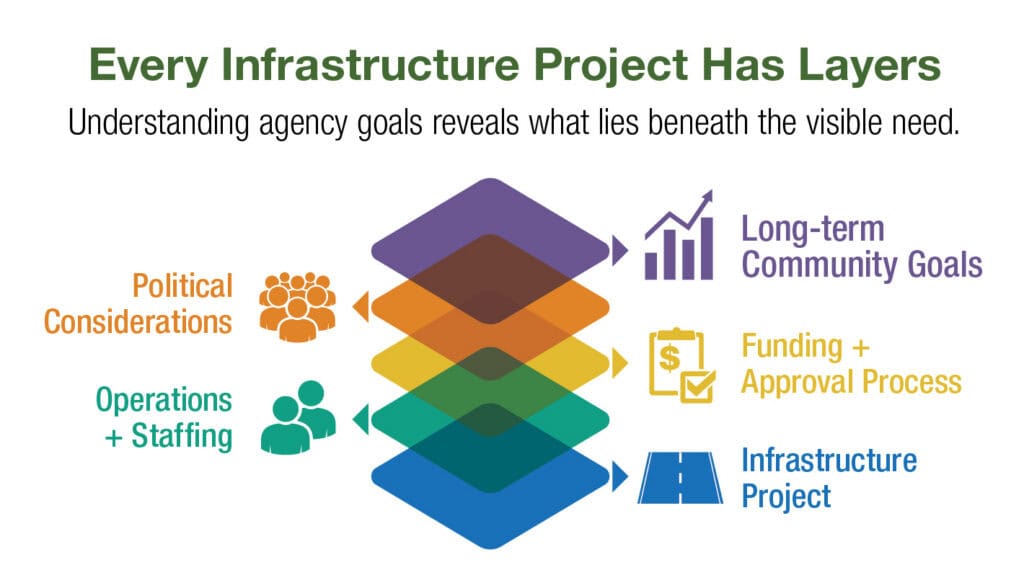
Strong relationships do not begin when a contract is signed. They take shape through early conversations, consistent follow-through, and genuine interest in what an agency is trying to accomplish, and they deepen as a consultant learns how that organization actually operates.
Consider a transportation project. On the surface, the need may appear to be obvious, as most communities have an abundance of roadway needs. Behind that assignment, staff may also be managing public complaints, a funding deadline, unmapped utility conflicts, elected official expectations, and economic development goals that will influence the corridor for decades.
Understanding that context requires more than technical familiarity. A state department of transportation approaches projects differently than a city public works department or a county agency. All would strive to provide a quality product, but they may have distinct procurement requirements, communication preferences, approval processes, and political considerations, even when the infrastructure involved is similar. Learning how decisions move through an organization—from initial idea to funding, approval, design, construction, and public communication—is what allows a consultant to ask sharper questions early and catch issues that a purely technical read of the scope would miss.
Those internal needs are also changing. Staffing shortages and increasingly complex projects have shifted the level of support many agencies require. In construction services, for example, an organization that once needed lower-level field personnel may now need licensed engineers, or management-level professionals who can lead and assist with project administration. A valued partner recognizes those shifts and adapts rather than waiting to be asked.
The Value of Integrated Engineering Services
Civil engineering projects rarely stay within one discipline. A construction relationship may uncover transportation planning needs. A roadway discussion may reveal water resources challenges. A municipal services assignment may expose funding gaps, staffing limitations, or development concerns.

When a firm can connect an agency with the right people without requiring them to start over with a new team, it creates meaningful value. Doing so requires working against some natural tendencies. Internal silos, business development incentives, and the desire to protect established relationships can all discourage cross-disciplinary collaboration. Organizations benefit most when consultants communicate across service areas and consider the full range of challenges involved.
The result is continuity. Agency staff do not have to repeatedly explain their community’s history, budget constraints, infrastructure priorities, or political landscape. They have a partner who already understands the context and can bring the appropriate resources forward.
Why Proactive Communication Matters in Public Infrastructure Projects
Timing matters as much as substance. When a schedule slips, a cost issue emerges, or a regulatory change alters what is possible, the instinct may be to wait, to gather more information, develop a solution, or avoid an uncomfortable conversation. That delay often makes the situation worse.
Agency leaders need time to respond, adjust internal expectations, brief boards or councils, and make informed decisions. An issue raised early can be addressed collaboratively. An issue disclosed late may leave decision-makers with few options and no chance to reduce the impact.
A valued partner sets realistic expectations from the beginning: avoiding promises that cannot be supported, explaining complex issues in plain language, being candid about risks, and responding promptly when questions arise. This matters especially in public-sector work, where staff often need to explain decisions to residents, elected officials, regulatory agencies, and funding partners. Clear communication from the consulting team gives them the confidence to do that well.
Measuring Success Beyond Plans and Reports
Reports, plan sets, permit packages, and construction records are important. Their lasting value, however, comes from what they help accomplish.
Did the project improve safety? Did it help the community secure funding? Did it reduce flooding? Did it make construction easier to manage? Did it relieve pressure on limited staff? Did it support economic development? Did it give elected officials and residents confidence in the decision-making process?
A strategic partner keeps those outcomes in view. Success is not simply completing an assignment; it is helping an organization achieve its broader goals. That perspective leads to better questions from the start, rather than asking only what must be delivered.
Supporting Clients Beyond Project Completion

Strong relationships continue after the final deliverable has been submitted. Following up after completion, assisting with implementation, discussing lessons learned, and sharing relevant information all strengthen the connection.
Agency staff may not always know which funding opportunities are available, what regulatory changes are approaching, or how another community addressed a similar challenge. A consultant who shares useful insights between projects becomes an ongoing resource rather than someone who appears only when work is available. Continued engagement also helps future projects begin from a stronger position: the consulting team already understands the history and priorities, and both sides can build on prior experience.
How Can Engineering Consultants Earn Trusted Advisor Status?
Trusted advisor status is not created by a title, contract, or marketing message. It is earned through consistent actions: arriving prepared, communicating honestly when news is difficult, remaining curious about evolving needs, and bringing the right people forward rather than protecting internal territory.
The consultants who do this well are not always the ones with every answer. They are the people agencies call first, because they have earned confidence in their ability to listen, respond, and find the right path forward.
Contact us to see how a strategic engineering partnership can strengthen your outcomes.